
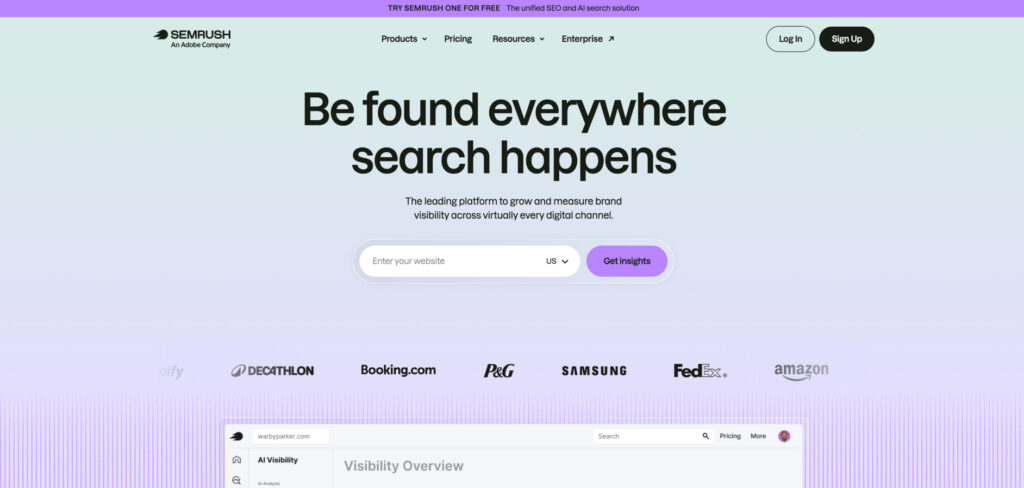
A single platform that joins product and category keyword research, site audits, and rank tracking with competitor analysis and AI-search visibility — everything a store needs in one login.
Pricing: Pro $139.95/mo · Guru $249.95/mo · Business $499.95/mo · 14-day free trial
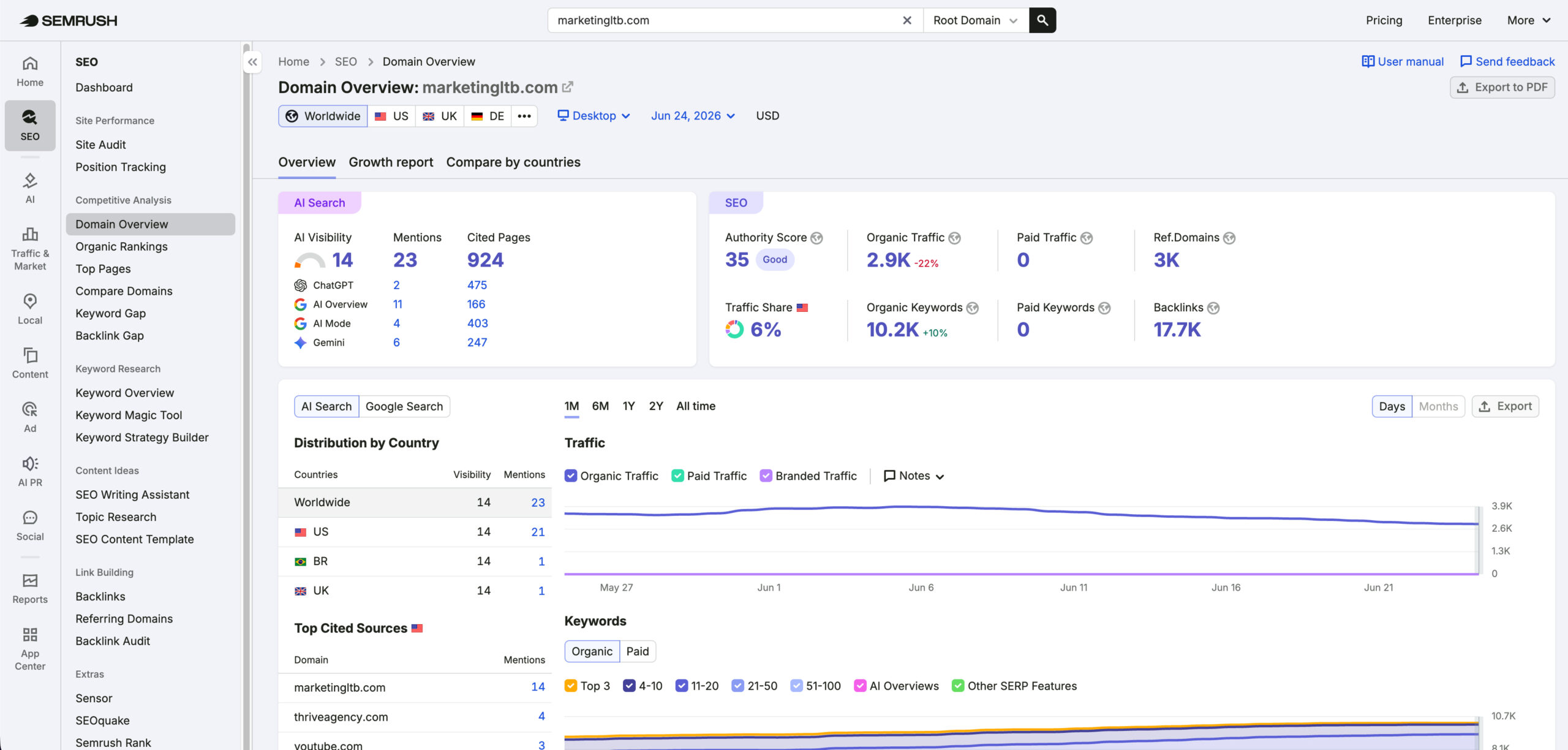
All-in-one platforms remain the Swiss Army knives of search, and for ecommerce Semrush packs the widest toolset into a single subscription. Keyword research, a site auditor that handles large catalogs, position tracking, and competitor gap analysis sit side by side, and its newer AI-visibility tracking shows whether your products surface in AI answers. For most store owners, it’s the tool they open first every morning.
The breadth is the draw: you can move from a category-page keyword report to a technical crawl to a backlink analysis without juggling exports between tools, and white-label reporting ties it together for clients. Dedicated crawlers like Screaming Frog go deeper on technical detail, but nothing mainstream matches Semrush for covering the whole job in one place.
The trade-offs are price and learning curve. Semrush is among the priciest tools here, the dashboard can overwhelm newcomers, and crawl and keyword limits on the entry plan fill up fast for big catalogs. A 14-day free trial makes it easy to test before committing.
Consider Semrush if:
Skip Semrush if:
An enterprise SEO platform built for large retailers, pairing deep content recommendations with real-time data and forecasting across huge product catalogs.
Pricing: Custom enterprise pricing · demos offered, no public free trial
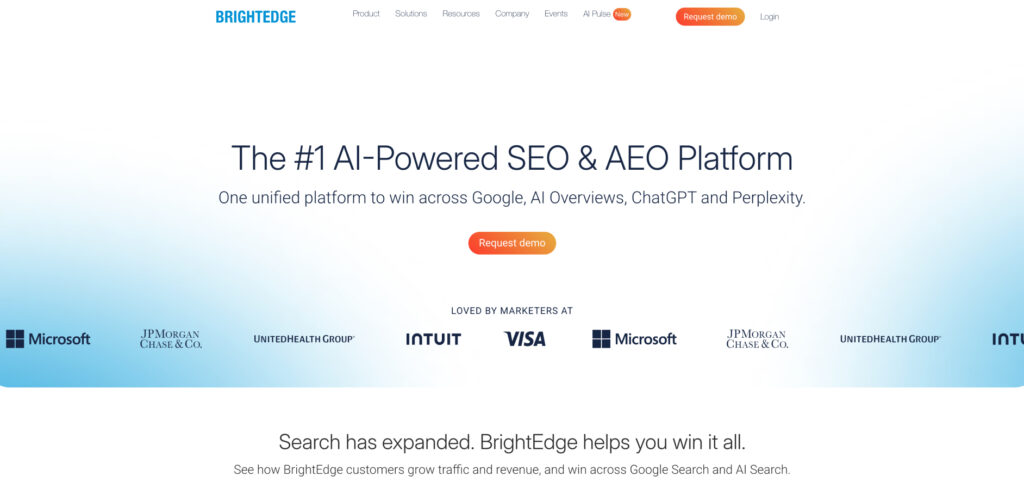
When a large retailer needs to manage SEO across tens of thousands of product and category pages, BrightEdge is the platform enterprise teams reach for. Its Data Cube surfaces opportunities at scale, its content recommendations guide writers toward what ranks, and its forecasting helps justify SEO investment to executives who think in revenue.
What separates it from mid-market suites is depth and integration: it ties organic performance to business outcomes, plugs into enterprise analytics stacks, and is built for teams coordinating SEO across many stakeholders. That power comes with enterprise pricing and onboarding, so it makes sense for big catalogs, not small stores.
Consider BrightEdge if:
Skip BrightEdge if:
Backed by one of the largest keyword and backlink indexes in the business, Ahrefs is the go-to for finding the product and category terms worth targeting.
Pricing: Lite ~$129/mo · Standard $249/mo · Advanced $449/mo · limited free Webmaster Tools
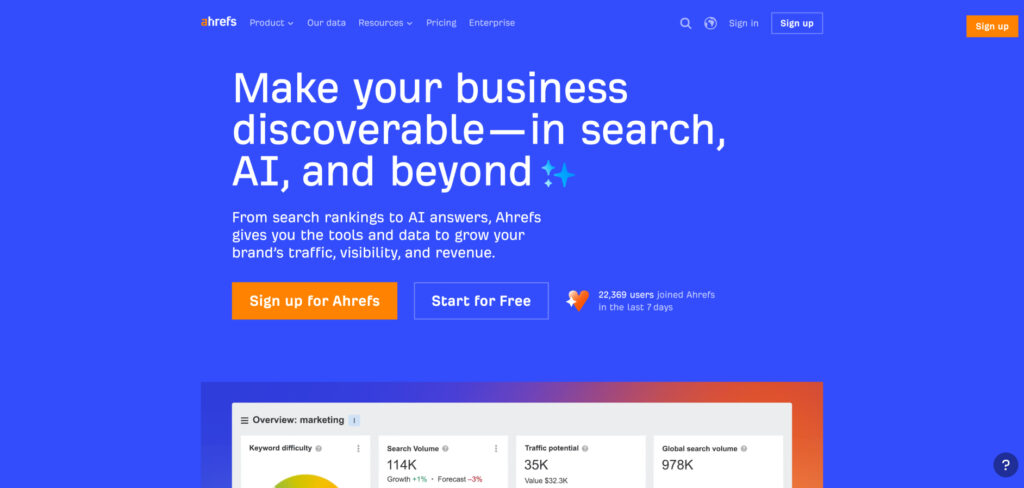
Ahrefs built its reputation on the size and freshness of its keyword and backlink data, and that advantage still holds in 2026. For ecommerce, its Keywords Explorer is excellent at uncovering the long-tail product and category queries shoppers actually type, while Site Explorer shows exactly which pages and links are sending competitors traffic.
The appeal is data depth: parent-topic grouping, traffic estimates, and SERP history help you prioritize which category pages to build and which competitors to chase for links. The interface rewards a little learning, and there’s no perpetual free tier beyond the limited Webmaster Tools, but for research-led teams it’s hard to beat.
Consider Ahrefs if:
Skip Ahrefs if:
A desktop crawler that maps every URL on your store, surfacing broken links, duplicate content, redirect chains, and the technical issues that quietly sink large catalogs.
Pricing: Free up to 500 URLs · paid license £259/yr (about $329)
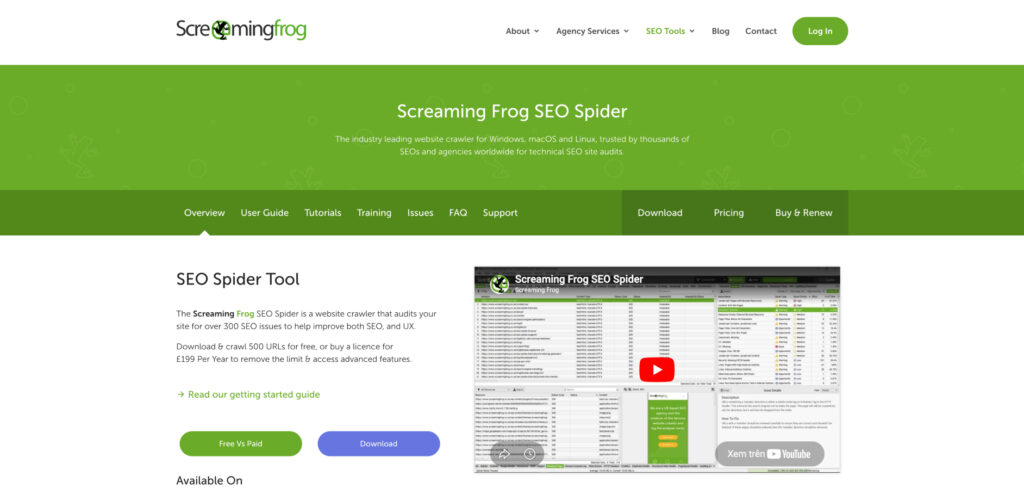
Big ecommerce sites generate technical problems faster than any other kind of website — faceted navigation, out-of-stock pages, near-duplicate variants — and Screaming Frog is the tool SEOs trust to find them. It crawls your site the way a search engine does and flags broken links, missing tags, redirect chains, duplicate titles, and orphaned pages in one pass.
It pairs with Google Analytics, Search Console, and PageSpeed data, and handles JavaScript rendering for modern storefronts. The interface is utilitarian and the free tier caps at 500 URLs, but the paid license is inexpensive for the depth it delivers, making it a near-default for technical audits.
Consider Screaming Frog SEO Spider if:
Skip Screaming Frog SEO Spider if:
On-page SEO guidance built right into Shopify, handling titles, meta descriptions, schema, and readability without touching code.
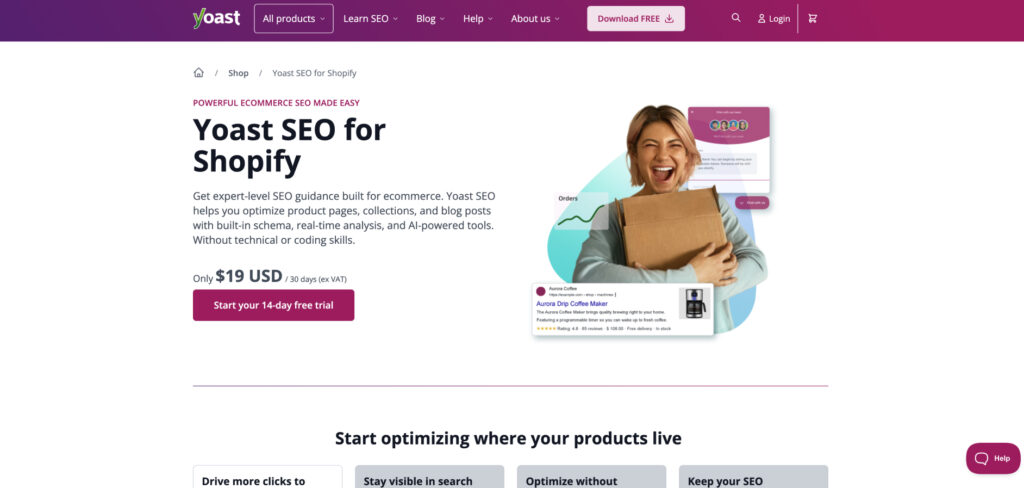
Pricing: About $29/mo, or roughly $19/mo billed annually via the Shopify App Store
For stores running on Shopify, Yoast brings its familiar on-page workflow straight into the admin. It guides you on titles and meta descriptions, generates structured data so products are eligible for rich results, manages canonicals to tame duplicate variant pages, and flags readability issues as you write product and blog copy.
The value is simplicity: it puts solid SEO fundamentals within reach of store owners who aren’t specialists, with templates that apply settings across many products at once. It won’t research keywords or crawl your whole site, but as an in-platform optimizer for Shopify merchants it’s one of the easiest wins available.
Consider Yoast SEO for Shopify if:
Skip Yoast SEO for Shopify if:
A purpose-built suite for Amazon sellers, covering product keyword research, listing optimization, and rank tracking inside the marketplace’s own search engine.
Pricing: Free starter plan · Platinum from ~$39/mo · Diamond ~$279/mo
Search on Amazon plays by different rules than Google, and Helium 10 is built specifically for it. Tools like Cerebro and Magnet surface the product keywords shoppers use, while its listing optimizer helps you weave them into titles and bullets that the marketplace algorithm rewards — and that real buyers actually click.
Beyond keywords it tracks marketplace rankings, monitors competitors, and watches for listing hijackers, making it a near-complete toolkit for serious sellers. If your revenue runs through Amazon or other marketplaces rather than your own domain, this is the kind of optimization a general SEO suite simply doesn’t cover.
Consider Helium 10 if:
Skip Helium 10 if:
Analyzes the top-ranking pages for a term and gives writers real-time, color-coded guidance on terms, headings, and length for category copy and buying guides.

Pricing: Essential $99/mo ($79/mo annual) · Scale $219/mo ($175/mo annual) · 7-day money-back guarantee
Ecommerce isn’t only product pages — category descriptions, buying guides, and blog content do real ranking work, and Surfer makes optimizing them straightforward. It analyzes what’s already ranking for your target term and turns it into a live score as you write, so even non-specialists can hit the topical marks that correlate with ranking and AI citation.
Its Google Docs and CMS integrations keep the workflow tight, and the affordable entry tier plus optional AI drafting make it the most approachable serious content tool for most teams. As search rewards topical completeness over keyword stuffing, Surfer’s guidance pushes writers in exactly the right direction.
Consider Surfer SEO if:
Skip Surfer SEO if:
A dedicated rank tracker known for speed and accuracy, updating thousands of keyword positions on demand across locations and devices.
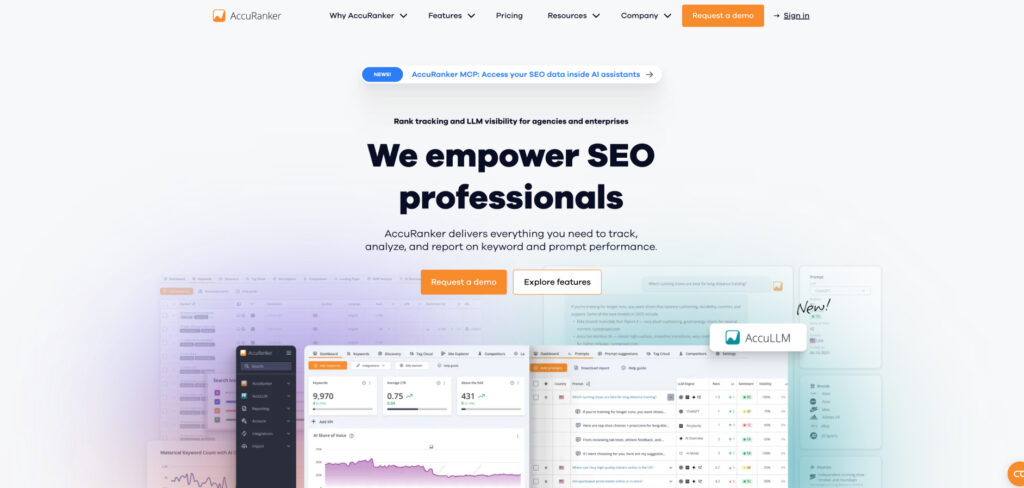
Pricing: From ~$129/mo by tracked keywords · 14-day free trial
When you need to know exactly where every product and category page ranks — and to prove movement to clients or bosses — AccuRanker does that one job better than most all-in-one suites. It refreshes positions fast, tracks across countries, languages, and devices, and now reports on share of voice and AI-feature presence alongside classic rankings.
It integrates with Google Search Console, Analytics, and Looker Studio so tracking data flows into the reports you already build. It’s a focused tool rather than a full platform, but for large keyword sets where ranking accuracy matters, its precision and speed are the selling points.
Consider AccuRanker if:
Skip AccuRanker if:
A capable, budget-friendly suite covering keyword research, rank tracking, site audits, and competitor analysis — most of what a growing store needs, for less.
Pricing: Essential from ~$65/mo · Pro ~$119/mo · Business ~$259/mo · 14-day free trial
SE Ranking has become the value pick for stores that want a real all-in-one toolkit without Semrush or Ahrefs pricing. It bundles keyword research, accurate rank tracking, a competent site auditor, and competitor analysis, plus on-page checks and reporting, into a single affordable subscription.
The data depth doesn’t quite match the market leaders, and very large enterprises will outgrow it, but for small and mid-sized ecommerce teams the coverage-to-price ratio is excellent. Flexible plans that scale by keyword volume keep costs predictable as you grow.
Consider SE Ranking if:
Skip SE Ranking if:
Free, first-party data from Google on how your store actually performs in search — which queries you appear for, where you rank, and what’s blocking indexing.
Pricing: Free
Every store should be using Google Search Console, full stop. It’s the only tool that shows Google’s own view of your pages — the queries you appear for, your average positions, click-through rates, and any crawl or indexing problems holding products back. For ecommerce, its index-coverage and enhancement reports are invaluable for catching issues across a large catalog.
As Google has folded AI Overviews into results, that performance data increasingly reflects AI-surfaced impressions too, giving you a free, if partial, read on visibility. It won’t research keywords, crawl deeply, or track competitors, but paired with a crawler and a content tool it forms a genuinely capable no-cost foundation before you spend a dollar.
Consider Google Search Console if:
Skip Google Search Console if: