
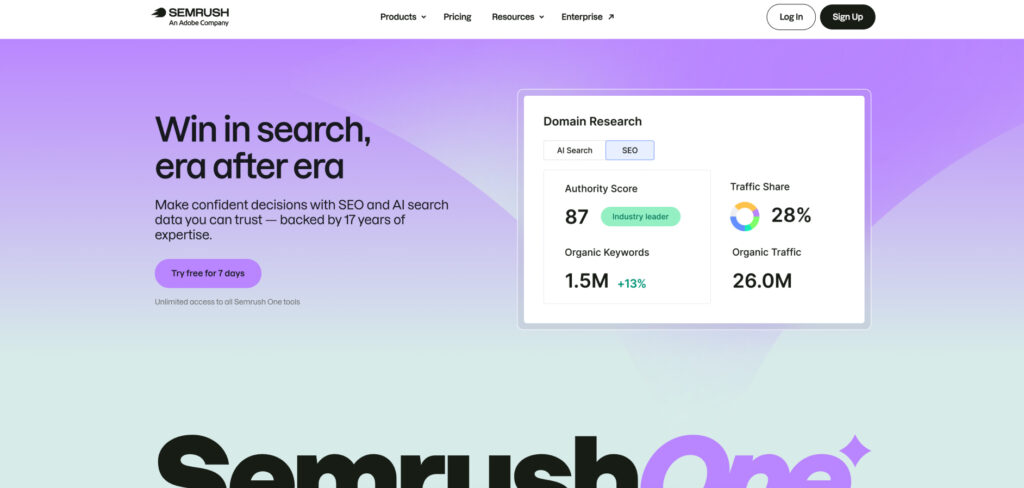
A single login that joins classic SEO — keyword research, audits, rank tracking — with AI-search visibility tracking across ChatGPT, Perplexity, Gemini, and Google’s AI Overviews.
Pricing: Semrush One (AI + SEO bundle) from $199/mo · Pro $139.95/mo · Guru $249.95/mo · Business $499.95/mo · 14-day free trial
All-in-one platforms are still the Swiss Army knives of search, and in 2026 Semrush is the one that has folded AI visibility most convincingly into an existing suite. Its AI Toolkit tracks how your brand shows up in AI-generated answers and which sources those models pull from, sitting right alongside the keyword research, site audits, and competitor analysis teams already rely on. For most marketers, it’s the tool they open first every morning.
The headline in 2026 is breadth without a second subscription: you can move from a classic ranking report to an AI share-of-voice dashboard without leaving the platform, and white-label reporting ties both stories together for clients. Dedicated trackers like Profound go deeper on answer-engine intelligence, but nothing mainstream matches Semrush for covering old and new search in one place.
The trade-offs are price and learning curve. Semrush is among the priciest tools here, the dashboard can overwhelm newcomers, and the richest AI features sit in the higher One bundle rather than the entry plan. A 14-day free trial makes it easy to test before committing.
Consider Semrush One if:
Skip Semrush One if:
The enterprise standard for answer-engine intelligence: it tracks brand mentions, citations, and sentiment across major LLMs and shows the exact sources shaping those answers.
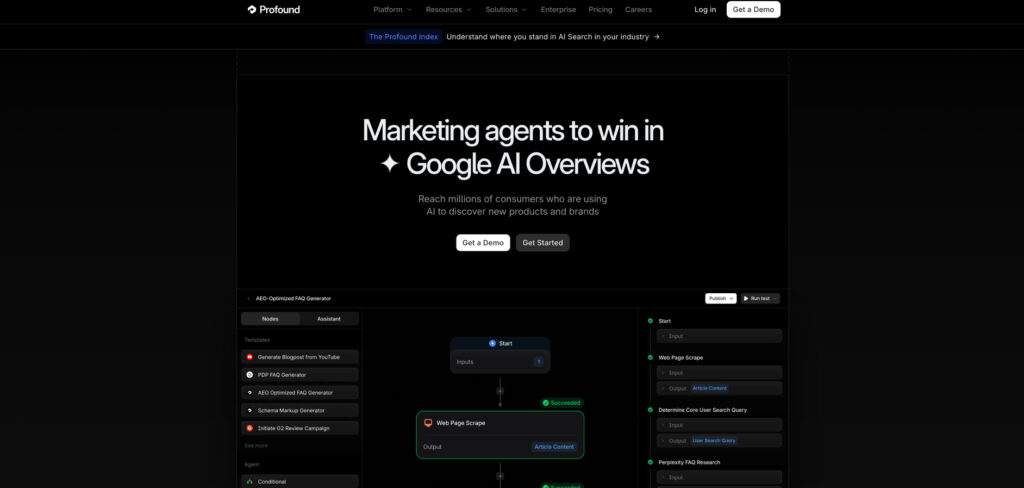
Pricing: Starter from ~$82.50/mo (annual, 50 prompts) · Growth ~$332.50/mo (100 prompts). Enterprise custom · demos offered, no free trial
When an enterprise brand needs to understand — and defend — how it appears across ChatGPT, Perplexity, Gemini, and AI Overviews, Profound is the tool the largest teams reach for. It goes beyond a single share-of-voice score to surface the prompts that trigger mentions, the competitors who win the ones you lose, and the underlying pages and forum threads the models are citing.
That source-level visibility is what separates it from cheaper monitors: it turns AI visibility from a metric you watch into a workflow you can act on. Backed by heavy funding and a roster of large clients, it’s built for teams that treat answer-engine presence as a board-level priority rather than an experiment.
Consider Profound if:
Skip Profound if:
The most accessible way to start monitoring brand mentions and citations across ChatGPT, Perplexity, Google’s AI Overviews, and Microsoft Copilot — at a price freelancers can stomach.
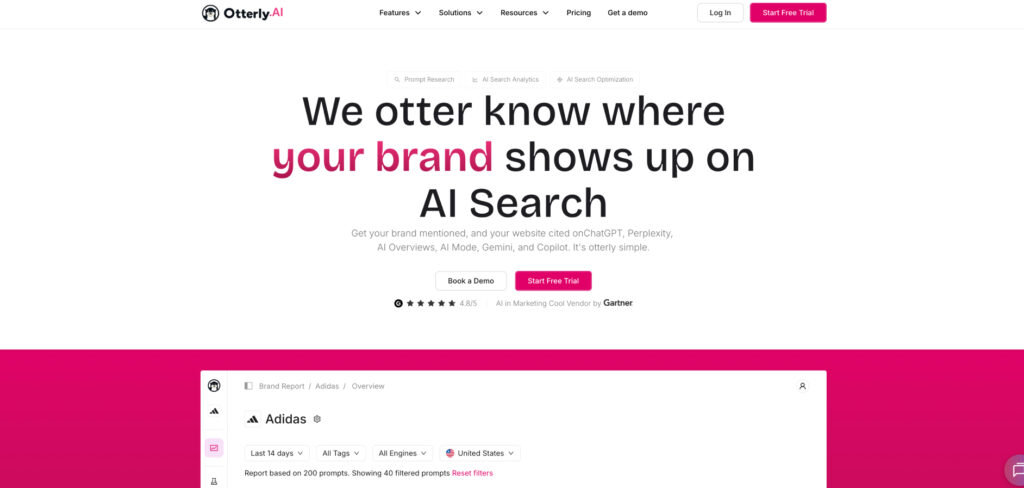
Pricing: Lite from $29/mo (annual; 15 prompts, 4 engines) · Standard ~$160/mo (100 prompts). Gemini and Google AI Mode available as add-ons · free trial
Otterly is the value sweet spot for smaller brands, freelancers, and agencies that want ongoing AI search monitoring without an enterprise contract. Setup is straightforward, and a nice touch for anyone already doing SEO is that it can turn your target keywords into related LLM prompts, so you’re tracking the questions your audience actually asks.
It covers the major answer engines, benchmarks you against a handful of competitors, and delivers enough data to shape a real generative-engine-optimization strategy. The catch is capacity: prompt limits fill up fast, so if you manage many clients or topics, check that the higher tiers still make economic sense before you scale.
Consider Otterly.AI if:
Skip Otterly.AI if:
A fast-growing analytics-first tracker favored by mid-market teams and agencies, with a clean interface, competitor benchmarking, and a Looker Studio connector.
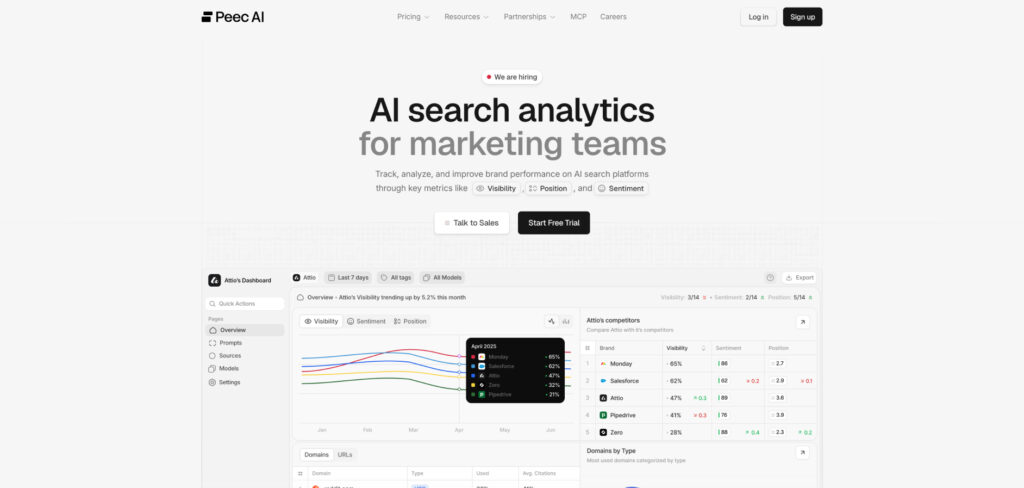
Pricing: From about €89/mo · higher tiers scale by prompts and engines. Free trial available
Peec has become the challenger that mid-market marketing teams and agencies keep shortlisting. Its interface is friendly, its competitor comparisons are easy to read, and its Pitch Workspaces are designed specifically to help agencies win new business by sharing AI-visibility reports that put a prospect’s data next to rivals’.
Under the hood it leans on UI scraping that simulates real user behavior rather than hitting APIs, which tends to produce results closer to what an actual person sees in an AI answer. A Looker Studio connector pipes live visibility and source data into the dashboards teams already use, and a layer of smart suggestions proposes the most relevant prompts and competitors to track.
Consider Peec AI if:
Skip Peec AI if:
Analyzes the top-ranking pages for your target term and gives writers real-time, color-coded guidance on terms, headings, and length, with optional AI drafting.

Pricing: Essential $99/mo ($79/mo annual) · Scale $219/mo ($175/mo annual), 7-day money-back guarantee
Surfer turns SERP analysis into a live score as you write, which makes it easy for writers — even non-SEOs — to hit the marks that correlate with ranking, and increasingly with being cited in AI answers. Its Google Docs and WordPress integrations keep the workflow tight, and the affordable entry tier plus optional AI articles make it the most approachable serious content tool for most teams.
As search shifts toward AI Overviews, optimizing for topical completeness rather than keyword stuffing matters more than ever, and Surfer’s guidance pushes writers in exactly that direction. For teams publishing regularly, it shortens the research-to-draft loop without sacrificing quality.
Consider Surfer SEO if:
Skip Surfer SEO if:
A content optimizer built for agencies that need repeatable results, pairing NLP-driven recommendations with AI-search tracking and expert coaching.

Pricing: Pricing scales by seats and projects · agency-focused tiers, Free trial available
Rankability is aimed squarely at agencies that need to scale content output without scaling chaos. Its Content Optimizer blends IBM Watson and Google NLP to generate topic recommendations that tend to track closely with what ranks, and it bundles AI-search visibility tracking so teams can see whether optimized pages are actually getting surfaced in answer engines.
What sets it apart for client work is the emphasis on process: the platform pairs its analysis with coaching and workflows designed to make SEO repeatable across a team, rather than dependent on one expert. For a solo creator that may be more structure than you need, but for an agency proving ROI it’s a strong fit.
Consider Rankability if:
Skip Rankability if:
A premium, editorial-first content tool favored by large teams for its topical-map approach, clean collaboration, and excellent Google Docs integration.
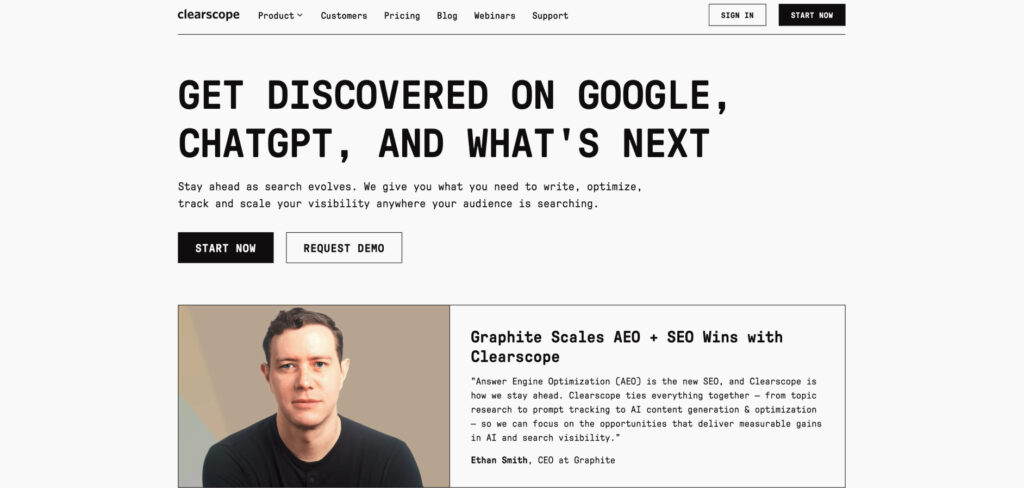
Pricing: From $170/mo (Essentials) · higher tiers custom
Clearscope focuses on content intelligence rather than churning out drafts: it helps teams understand what makes a page rank and where their topical authority has gaps. Its interface is clean, its Google Docs integration is excellent, and big content teams tend to prefer it when editorial quality and consistency matter more than raw volume.
In an AI-search world, that emphasis on genuine topical depth pays off — comprehensive, authoritative pages are the ones models tend to cite. Clearscope won’t track your AI mentions for you, but it’s a reliable way to build the kind of content that earns them.
Consider Clearscope if:
Skip Clearscope if:
Ahrefs’ answer-engine add-on, pairing the industry’s largest backlink index with tracking of how often your brand appears across AI answers.

Pricing: Brand Radar about $699/mo on top of an existing Ahrefs subscription. Ahrefs Lite/entry ~$99–$129/mo · Standard $249/mo
Ahrefs built its reputation on the largest and freshest backlink index in the business, and that data advantage still holds in 2026. Brand Radar layers AI-visibility tracking on top, so the same platform you use for link and competitor research can also report how often you surface in AI-generated answers.
The appeal is data depth and consolidation: if your team already lives in Ahrefs, adding answer-engine tracking to the same toolset is tidier than running a separate subscription. The catch is cost — Brand Radar is a significant add-on on top of an already premium suite, so it makes most sense for teams that need both link forensics and AI tracking at scale.
Consider Ahrefs Brand Radar if:
Skip Ahrefs Brand Radar if:
Turns a target keyword into a SERP-driven brief and a fast first draft, now with AI-visibility tracking baked in — a strong value for solo creators and small teams.
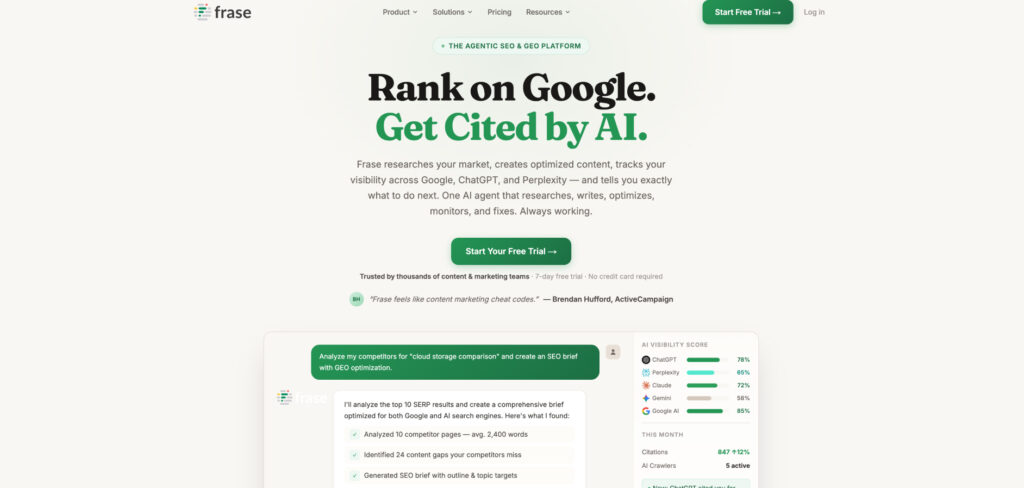
Pricing: Starter $49/mo ($39 annual) · Professional $129/mo ($103 annual) · Scale $299/mo. 7-day free trial, no card required
Frase scans the top results for your keyword — including People Also Ask — and uses NLP and topic modeling to clarify intent, outline the sections readers expect, and reveal content gaps. A real-time content score guides word count, headings, and coverage as you write, while the AI writer speeds up the drafting itself.
In 2026 it has leaned into the AI-search shift, adding tracking of how your content shows up across several AI platforms alongside its core brief-and-draft workflow. Pricing climbed from its bargain-basement origins, so older reviews quoting $15 plans are out of date, but it remains one of the more affordable ways to get serious briefs and optimization in a single tool.
Consider Frase if:
Skip Frase if:
Free, first-party data from Google on how your site actually performs in search — now including impressions and clicks from AI features.
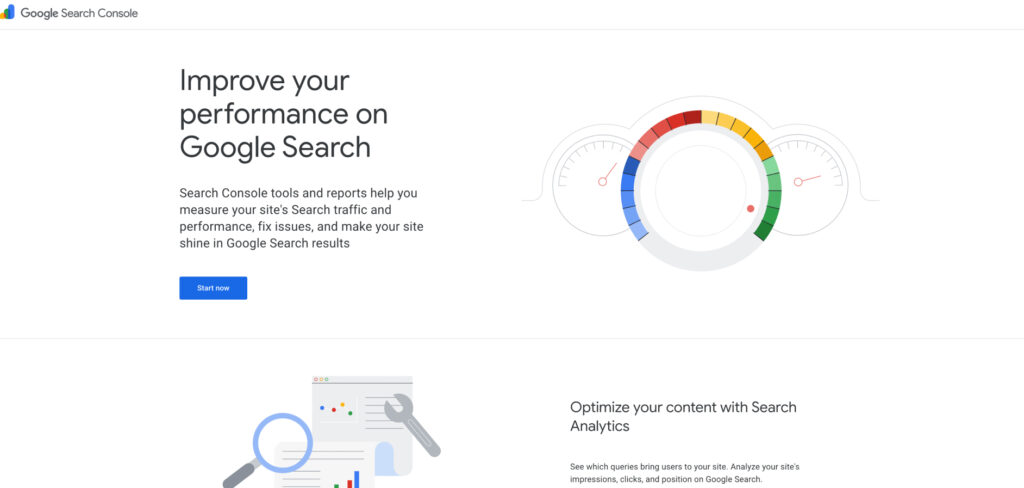
Pricing: Free
Every site should be using Google Search Console, full stop. It’s the only tool that shows you Google’s own view of your pages — which queries you appear for, where you rank, and what’s blocking pages from being indexed. As Google has folded AI Overviews and AI Mode into results, that performance data increasingly reflects AI-surfaced impressions too, giving you a free, if partial, read on AI visibility.
It won’t track ChatGPT or Perplexity, and it won’t tell you why a model cites you. But paired with a free AI-monitoring trial and a content tool, it forms a genuinely capable no-cost foundation before you spend a dollar on paid platforms.
Consider Google Search Console if:
Skip Google Search Console if: