
A single platform that joins keyword and intent research, site audits, and rank tracking with AI-search visibility — and reporting that maps organic effort to pipeline.
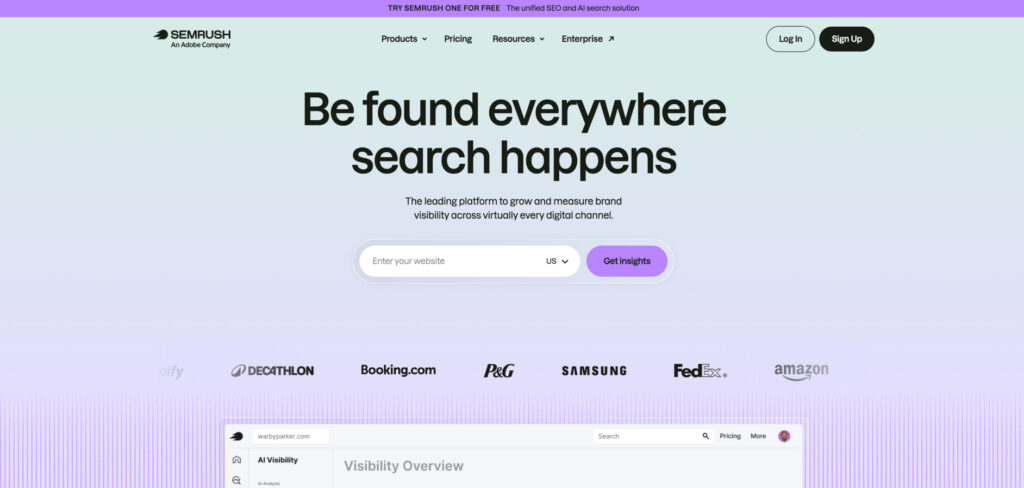
Pricing: Pro $139.95/mo · Guru $249.95/mo · Business $499.95/mo · AI Toolkit add-on from $99/mo · 14-day free trial
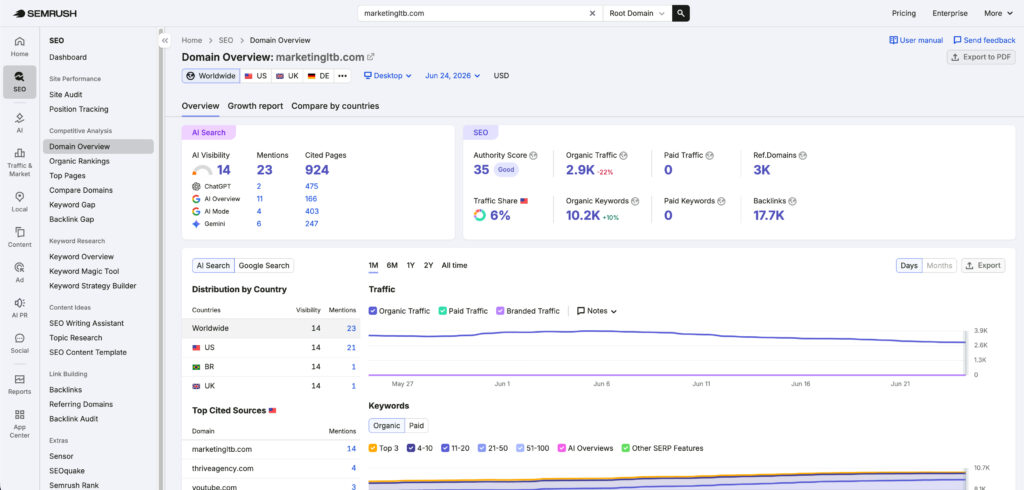
All-in-one suites are still the workhorses of B2B search, and Semrush is the one most teams open first. Its keyword and Keyword Magic tools surface the long-tail, high-intent terms that matter for considered B2B purchases, while site audits, position tracking, and competitor analysis cover the rest of the stack from one login.
For B2B specifically, the appeal is connecting work to outcomes: guided workflows help non-specialists find opportunities and fix issues, and the reporting turns rankings, traffic, and now AI mentions into a story marketing, sales, and leadership can all read. The AI Toolkit tracks how your brand shows up across ChatGPT, Perplexity, Gemini, and AI Overviews and which sources those models cite.
The trade-offs are price and breadth-induced complexity. Semrush sits at the premium end, the dashboard can overwhelm newcomers, and the richest AI features live in an add-on rather than the entry plan. A 14-day free trial makes it easy to test against your own keywords first.
Consider Semrush if:
Skip Semrush if:
The industry’s largest and freshest backlink index, paired with strong keyword research, rank tracking, and an API that feeds B2B business-intelligence dashboards.
Pricing: Lite ~$129/mo · Standard $249/mo · Advanced $449/mo · Enterprise custom · API and Brand Radar add-ons available
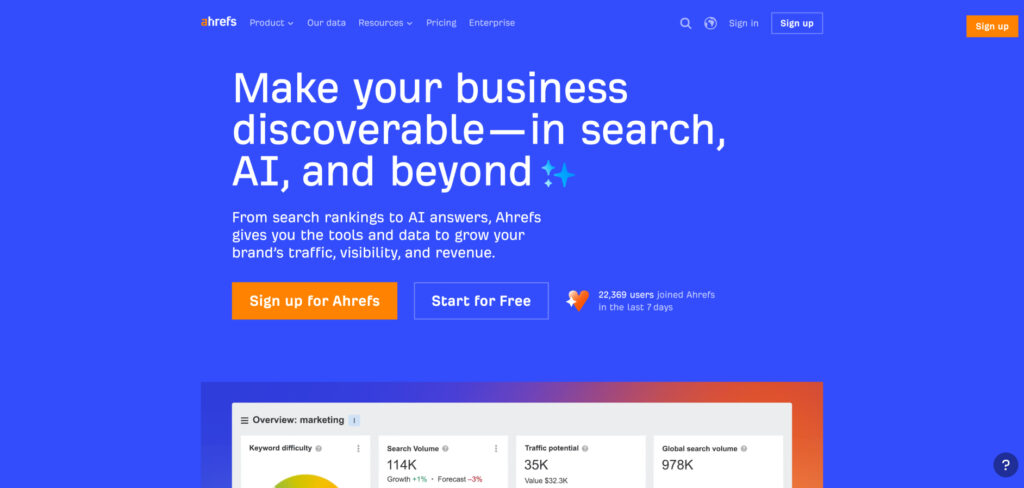
Ahrefs built its reputation on the deepest, most up-to-date link index in the business, and in 2026 that data advantage still holds. For B2B teams competing in established categories, it’s the sharpest tool for understanding who’s linking to rivals, where authority gaps sit, and which content earns links worth chasing.
Beyond links, Ahrefs covers keyword research, content gap analysis, and rank tracking, and its API lets larger teams pipe live ranking and backlink data into Looker Studio or internal BI dashboards — useful when SEO has to sit alongside other revenue metrics. A Brand Radar add-on layers answer-engine visibility on top of the same platform.
The catch is that the richest limits and API access sit in higher tiers, and add-ons stack on an already premium base. For teams whose strategy genuinely hinges on links and competitive data, though, few tools match it.
Consider Ahrefs if:
Skip Ahrefs if:
An enterprise-grade platform built for large B2B sites and global teams, with unlimited-keyword tracking, deep technical analysis, and SLAs.
Pricing: Essentials from ~$750/mo · full enterprise solutions custom quoted · unlimited users on some packages
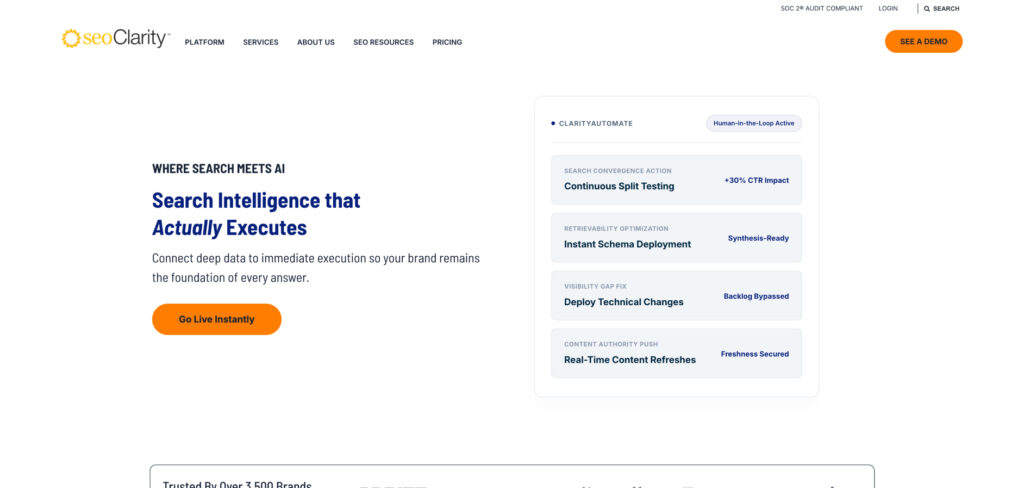
When a B2B organization manages thousands of pages across markets and needs more than a seat-limited SaaS tool, seoClarity is built for that scale. It tracks massive keyword sets, supports unlimited users on certain plans, and bundles specialized service-level agreements that enterprise procurement teams expect.
Its AI features — Clarity Automations and ClarityAI — help large teams streamline repetitive analysis and focus on strategy, while custom bundles adapt the toolkit to whether you need daily rank tracking for huge keyword volumes or deep technical monitoring across complex site structures.
This is a platform you buy through a sales conversation, not a self-serve trial, and pricing reflects the enterprise positioning. For smaller B2B teams it’s overkill; for global ones it’s purpose-built.
Consider seoClarity if:
Skip seoClarity if:
A technical SEO and site-intelligence platform built for large, complex B2B sites, crawling millions of URLs to surface crawlability, indexation, and site-health issues.
Pricing: Custom pricing by crawl volume and projects · enterprise-focused · demos offered
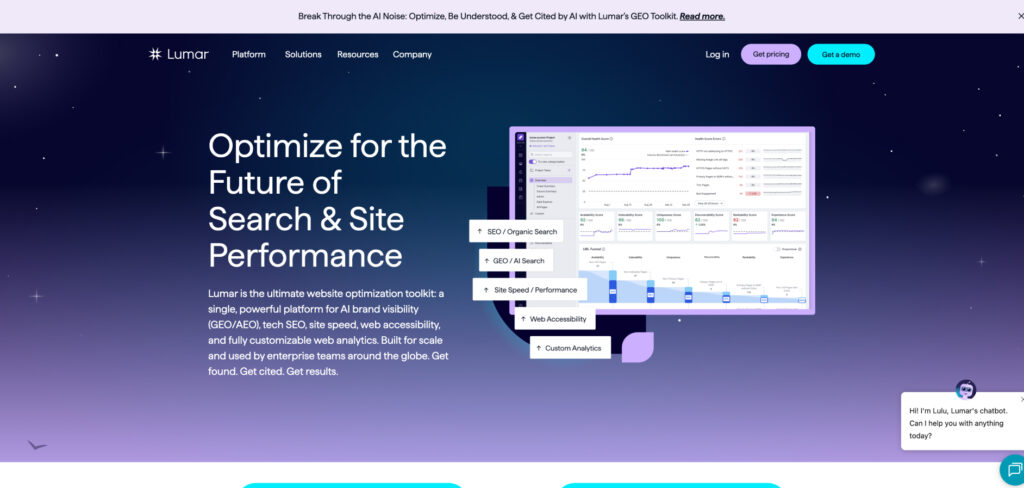
For B2B sites that have grown into sprawling resource centers, documentation hubs, and gated content libraries, technical health quietly decides how much of that content search engines actually see. Lumar (formerly Deepcrawl) is built for exactly that problem at the big-site end of the market.
It crawls large architectures to flag broken links, indexation gaps, redirect chains, slow templates, and structured-data issues, then helps teams prioritize fixes by impact. Automated monitoring catches regressions before they bleed into rankings — valuable when a single template change can affect thousands of pages.
It’s a specialist tool rather than an all-in-one, so you’ll still need research and content platforms alongside it. But for keeping a complex site crawlable and indexable, it’s among the strongest options.
Consider Lumar if:
Skip Lumar if:
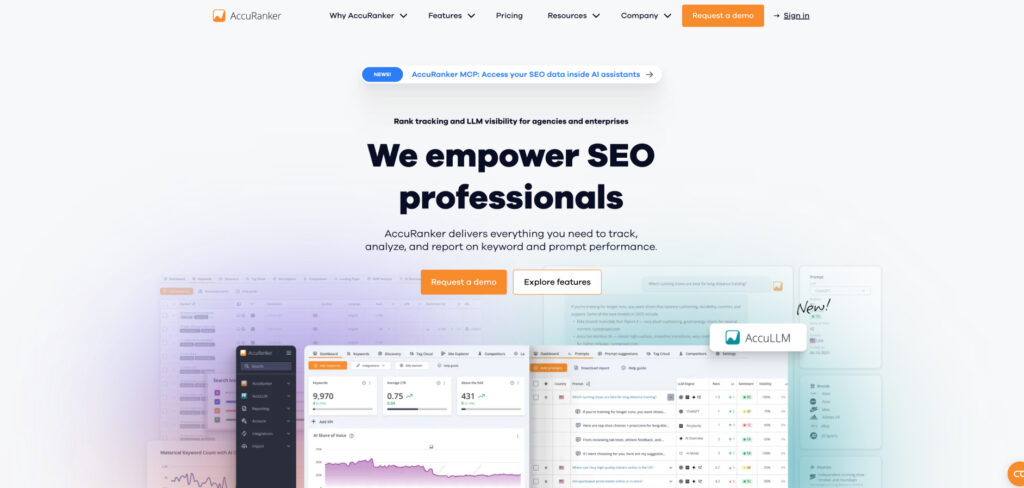
A fast, accurate rank tracker with on-demand position updates and a Share of Voice metric built for executive B2B dashboards.
Pricing: Plans scale by tracked keywords · 14-day free trial · annual discounts available
Rank tracking is a commodity until you need it to be exact and immediate — and that’s where AccuRanker earns its place in a B2B stack. It updates rankings on demand rather than on a fixed daily schedule, so you can check positions right before a stakeholder call or straight after publishing.
Its Share of Voice metric quantifies visibility across an entire tracked keyword set, which translates cleanly into the kind of single-number trend executives want to see. Integrations with Google Analytics and Search Console overlay traffic and conversion data on rank movements, helping connect position changes to business impact.
It’s deliberately focused: a precise tracker, not a research or content suite. For teams that already have those bases covered and want the sharpest rank data, it’s a strong, affordable specialist.
Consider AccuRanker if:
Skip AccuRanker if:
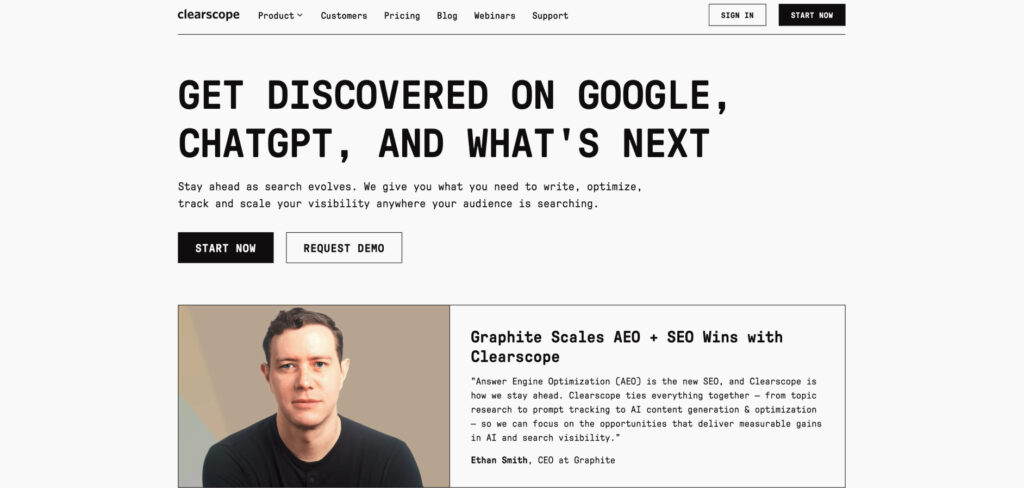
A premium content optimization tool that maps topical coverage against top-ranking pages, helping B2B teams build the comprehensive, authoritative content models tend to cite.
Pricing: Essentials $189/mo · Business and Enterprise custom · annual options
B2B content lives or dies on depth and authority, and Clearscope is built to engineer both. It analyzes the pages already ranking for your target term and gives writers a clear, readable picture of the terms, subtopics, and questions a comprehensive piece should cover.
Its topical-map view helps content leads spot and close coverage gaps systematically across a library — useful when you’re trying to own a whole category rather than a single keyword. The interface is clean enough that subject-matter experts who aren’t SEOs can follow it, which matters for technical B2B topics.
In an AI-search world, that emphasis on genuine topical depth pays off: thorough, authoritative pages are the ones answer engines tend to cite. Clearscope won’t track those mentions for you, but it’s a reliable way to build content that earns them. The cost is the main barrier for smaller teams.
Consider Clearscope if:
Skip Clearscope if:
Turns SERP analysis into real-time, color-coded writing guidance on terms, headings, and length, with briefs and optional AI drafting to speed the research-to-publish loop.

Pricing: Essential $99/mo ($79/mo annual) · Scale $219/mo ($175/mo annual) · 7-day money-back guarantee
Surfer turns competitive SERP analysis into a live score as writers work, making it easy for B2B teams — including non-specialist subject experts — to hit the coverage marks that correlate with ranking and increasingly with AI citation. Briefs scaffold an article before anyone writes a word.
Google Docs and WordPress integrations keep the workflow tight, and an affordable entry tier plus optional AI drafting make it the most approachable serious content tool for most teams. For B2B operations publishing regularly across a content calendar, it shortens the research-to-draft loop without sacrificing quality.
As search shifts toward AI Overviews, optimizing for topical completeness rather than keyword stuffing matters more than ever, and Surfer’s guidance pushes writers in exactly that direction.
Consider Surfer SEO if:
Skip Surfer SEO if:
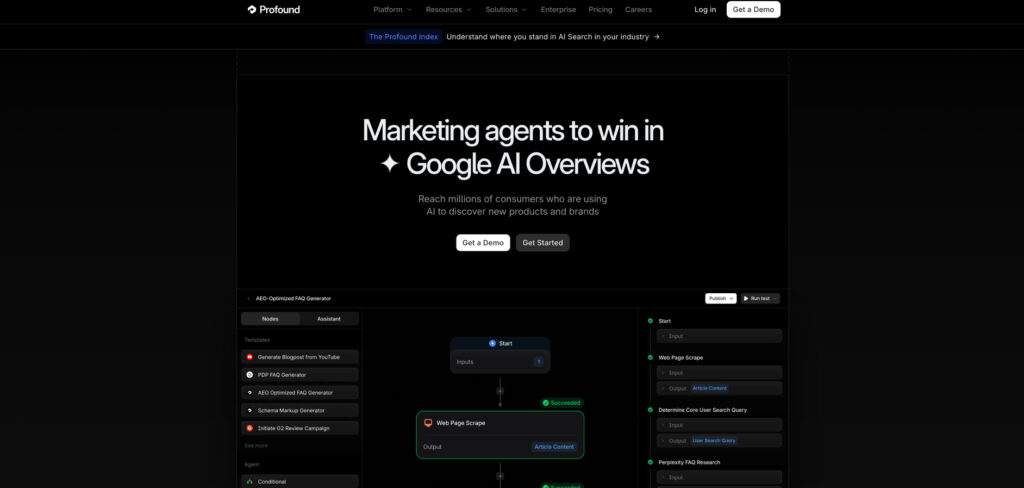
Answer-engine intelligence that tracks brand mentions, citations, and sentiment across major LLMs and shows the exact sources shaping how your B2B brand appears.
Pricing: Starter from ~$82.50/mo (annual, 50 prompts) · Growth ~$332.50/mo (100 prompts) · Enterprise custom · no free trial
With a large share of B2B buyers now starting product research in ChatGPT or Perplexity rather than Google, how your brand appears in AI answers has become a pipeline question, not a curiosity. Profound is the tool the most serious teams reach for to understand and defend that presence.
It goes beyond a single share-of-voice score to surface the prompts that trigger mentions, the competitors who win the ones you lose, and the underlying pages and forum threads the models cite. That source-level visibility turns AI presence from a metric you watch into a workflow you can act on — and it flags when an engine surfaces wrong information about your product or pricing.
It’s a specialist layer on top of a traditional SEO stack, not a replacement for it, and the prompt-limited entry pricing suits funded teams more than freelancers. For B2B brands treating answer-engine visibility as a board-level priority, it’s the depth benchmark.
Consider Profound if:
Skip Profound if:
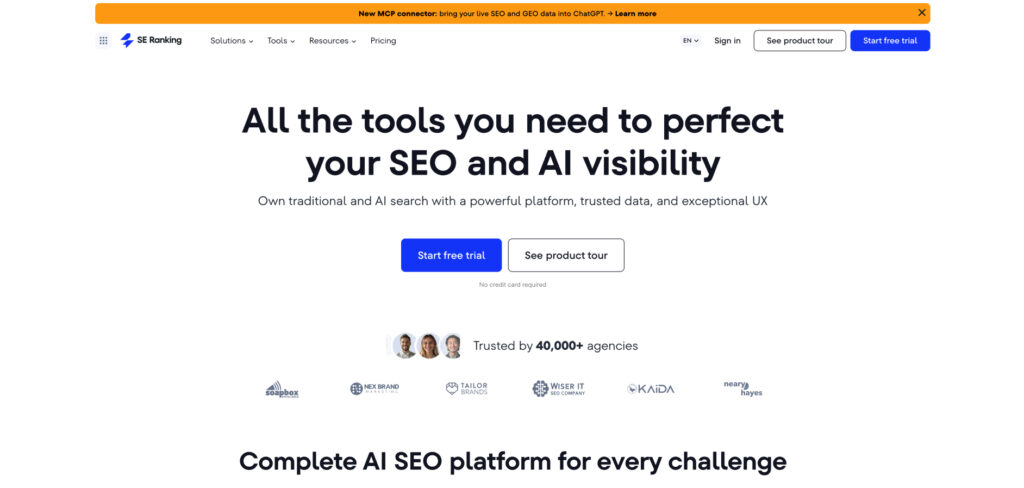
A versatile, budget-friendly platform offering rank tracking, audits, keyword research, and competitor analysis in a clean interface — strong value for small and mid-sized B2B teams.
Pricing: Essential from ~$65/mo · Pro ~$119/mo · Business ~$259/mo · 14-day free trial
SE Ranking delivers much of what the premium suites do at a noticeably gentler price, which makes it a sensible backbone for small and mid-sized B2B teams scaling their SEO without enterprise budgets. Rank tracking, site audits, keyword research, and competitor analysis all sit in one clean, approachable interface.
It lets teams analyze rankings across locations and devices, surface technical issues, and monitor backlink profiles, with reporting and project-management features that make it easy to share progress with stakeholders — important in B2B where marketing, sales, and leadership all want visibility.
It won’t match the data depth of Ahrefs or the enterprise muscle of seoClarity, but for the money it covers the fundamentals well and keeps the learning curve manageable.
Consider SE Ranking if:
Skip SE Ranking if:
Free, first-party data from Google on how your site actually performs in search — now including impressions and clicks from AI features.
Pricing: Free
Every B2B site should be using Google Search Console, full stop. It’s the only tool that shows Google’s own view of your pages — which queries you appear for, where you rank, and what’s blocking pages from being indexed, all from first-party data you can’t get anywhere else.
As Google has folded AI Overviews and AI Mode into results, that performance data increasingly reflects AI-surfaced impressions too, giving B2B teams a free, if partial, read on AI visibility alongside the index-coverage and Core Web Vitals reports that matter for technical health.
It won’t track ChatGPT or Perplexity, and it won’t tell you why a model cites you or how rivals are doing. But paired with a free AI-monitoring trial and a content tool, it forms a genuinely capable no-cost foundation before you spend a dollar on paid platforms.
Consider Google Search Console if:
Skip Google Search Console if: