
The deepest SEO dataset on the market, paired with My Reports and an Agency Growth Kit that turn keyword, audit, and AI-visibility data into branded client deliverables.
Pricing: Pro $139.95/mo · Guru $249.95/mo · Business $499.95/mo · Agency Growth Kit and My Reports add-ons priced separately · 7-day free trial
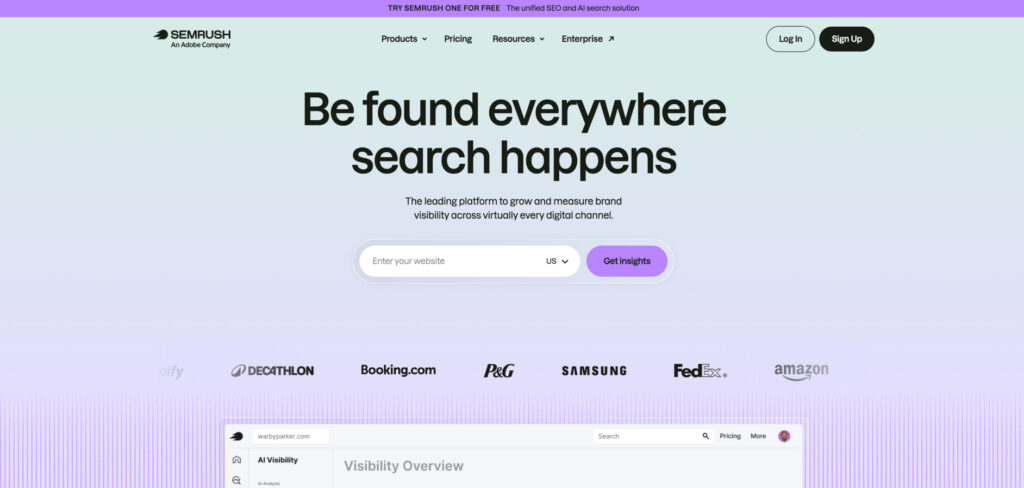
All-in-one suites are still the backbone of agency SEO, and Semrush remains the one with the most data behind it — keyword research, site audits, rank tracking, backlink analysis, and an AI Toolkit that tracks how clients surface in ChatGPT, Perplexity, Gemini, and Google’s AI Overviews. For most agencies it’s the platform everyone on the team has open by default.
For client work, the draw is My Reports, which consolidates Semrush data plus 20-odd external sources into one document, while Pro Reports add white-label branding, custom domains, and themes. The breadth means a strategist, a content writer, and an account manager can all live in the same tool rather than juggling three subscriptions.
The trade-offs are price and the per-seat math. Semrush is among the priciest options here, white-labeling sits behind add-ons rather than the base plan, and API access only arrives at the Business tier. A free trial makes it easy to test the workflow before you commit a team to it.
Consider Semrush if:
Skip Semrush if:
A genuinely full SEO suite — rank tracking, audits, research, and content — with a dedicated Agency Pack that adds white-label branding and client seats at roughly half the price of the big suites.
Pricing: Core $103.20/mo (annual) or $129/mo · Growth $223.20/mo (annual) or $279/mo · Agency Pack white-label add-on $69/mo (annual only) · 14-day free trial
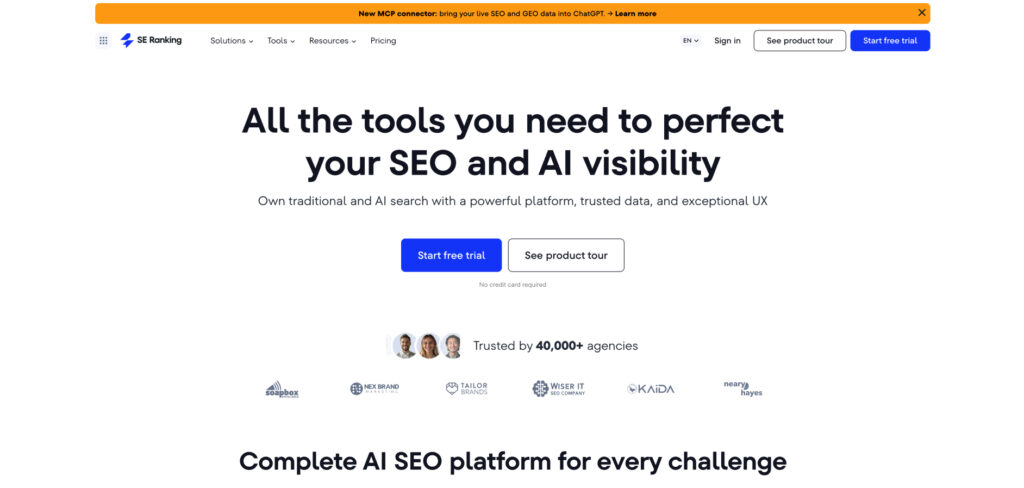
SE Ranking has become the default recommendation for small and mid-market agencies that want the capabilities of Semrush or Ahrefs without the enterprise invoice. The Growth plan is the usual agency home, with 30 projects, multiple manager seats, and all-time historical data, and it now bundles GEO prompt tracking so you can report AI visibility alongside classic rankings.
The Agency Pack is what makes it click for client work: white-label branding across the platform and reports, 30 client seats, unlimited scheduled reports with AI summaries, and a lead generator for prospecting. Stacking it onto Growth gives most agencies a complete, on-brand delivery system for well under what a single premium suite costs.
Watch the keyword math — limits are calculated as keywords multiplied by search engines tracked, so capacity fills faster than the headline number suggests. And white-labeling requires annual billing, so plan to commit before the branded reports turn on.
Consider SE Ranking if:
Skip SE Ranking if:
The industry benchmark for backlink and competitor intelligence, built on the largest and freshest link index, now with answer-engine visibility layered on through Brand Radar.
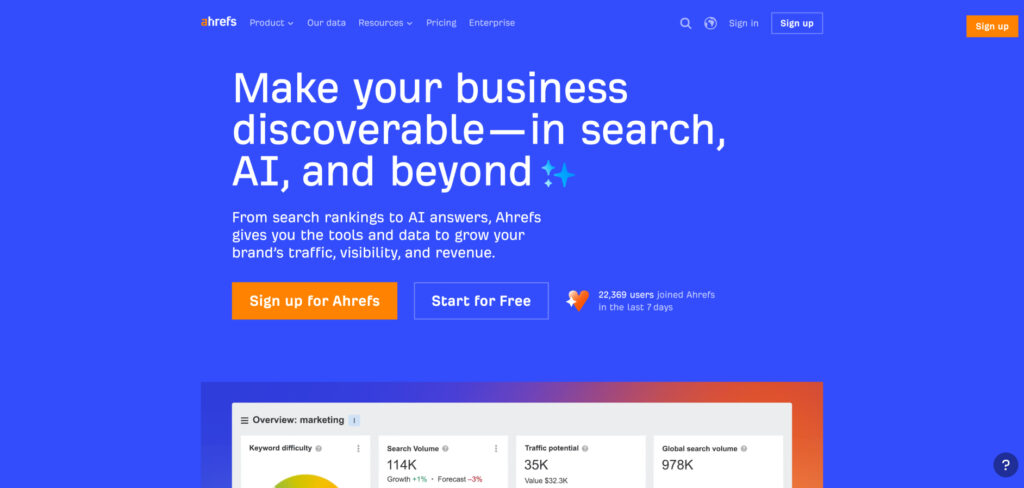
Pricing: Starter $29/mo · Lite $129/mo · Standard $249/mo · Advanced and Enterprise higher · per-seat add-ons; no free trial
Ahrefs earns its place in almost every serious agency stack on the strength of its link data. When the job is competitor backlink analysis, link-building prospecting, or explaining to a client why a rival outranks them, nothing matches its index for size and freshness. Standard is the plan most agencies settle on, unlocking far larger report exports and the crawl capacity to audit a roster of client sites.
It has also moved with the market: Brand Radar adds tracking of how often brands appear across AI answers, so the same platform you use for links can report on answer-engine visibility too. For agencies, that consolidation is tidier than running a separate AI tracker.
The catch is cost and seat pricing. There’s no free trial, lower tiers are restrictive, and adding team members climbs quickly — so Ahrefs makes the most sense when backlink and competitive work is central to what you sell.
Consider Ahrefs if:
Skip Ahrefs if:
A reporting platform built from day one for agencies, pulling SEO, PPC, social, and analytics data into automated, fully white-labeled client dashboards.
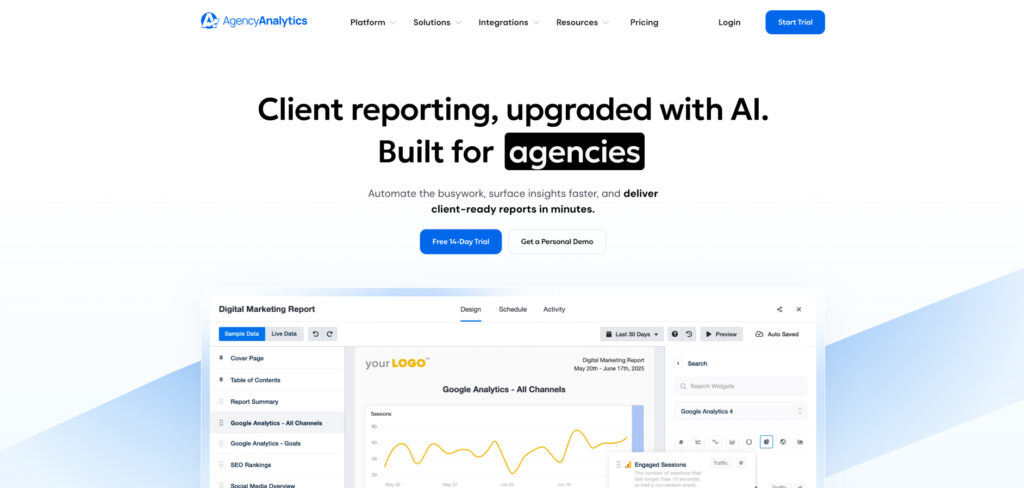
Pricing: Freelancer $79/mo (5 clients; ~$59/mo annual) · Agency from ~$179/mo · Agency Pro ~$479/mo · per-client overages apply · 14-day free trial
Where the suites above generate data, AgencyAnalytics exists to present it. With 75-plus integrations it stitches rankings, traffic, ad spend, and social metrics from across your stack into a single branded dashboard, then schedules and sends the report automatically — which is exactly the monthly grind most agencies want to stop doing by hand.
The white-label control is the selling point: custom domains, branded emails, and client logins make the work feel like it came from your agency rather than a patchwork of third-party exports. Smart Dashboards can even auto-populate the right metrics based on which integrations a client has connected.
The model is per-client, so cost scales with your roster rather than with features, and full white-labeling and API access live on the higher tiers. For a growing book of business that’s predictable; just price it against your client count, not the headline plan.
Consider AgencyAnalytics if:
Skip AgencyAnalytics if:
The definitive local SEO platform for agencies, with geo-grid rank tracking, citation and listing management, reputation tools, and white-label reporting included on every plan.
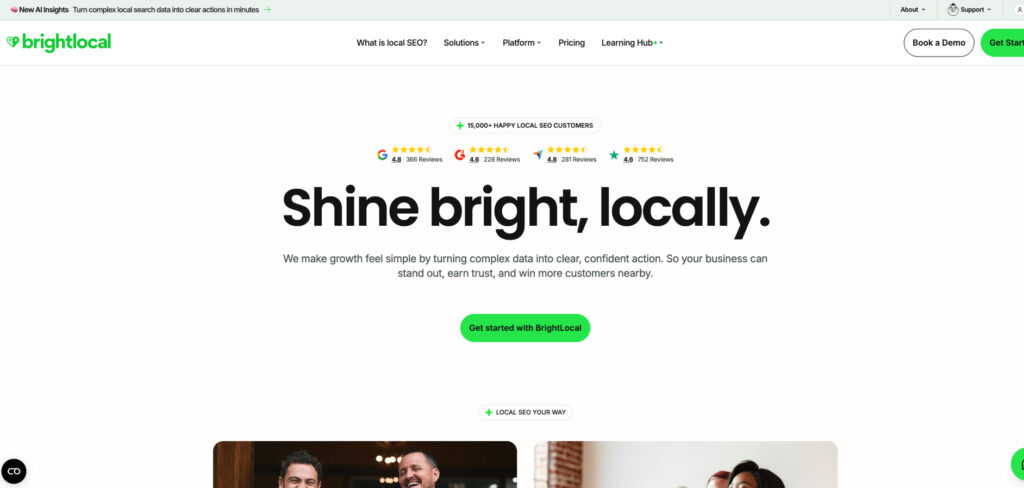
Pricing: Track $39/mo · Manage $49/mo · Grow $59/mo · white-label reporting included · per-location pricing scales · 14-day free trial, no card
For agencies serving multi-location and brick-and-mortar clients, BrightLocal is purpose-built in a way the general suites aren’t. Its Local Search Grid maps how a business ranks across a geographic area, the Citation Tracker monitors well over a hundred sources, and listing and reputation tools cover the Google Business Profile work that local clients actually care about.
The client-management experience is its quiet advantage: spin up a client, run an instant local audit, and hand over a branded PDF in minutes. White-label reporting is included rather than gated behind a premium tier, which keeps local retainers profitable even at modest fees.
It’s focused by design — there’s no broad keyword or backlink suite here, citation building is credit-based on top of the subscription, and it’s tuned for the 5-to-50-location range rather than enterprise scale. Pair it with a research tool and it covers the local job comprehensively.
Consider BrightLocal if:
Skip BrightLocal if:
A desktop crawler that gives technical SEOs the deepest, most granular view of a site — broken links, redirects, duplicate content, directives, and structured data — for a flat annual fee.
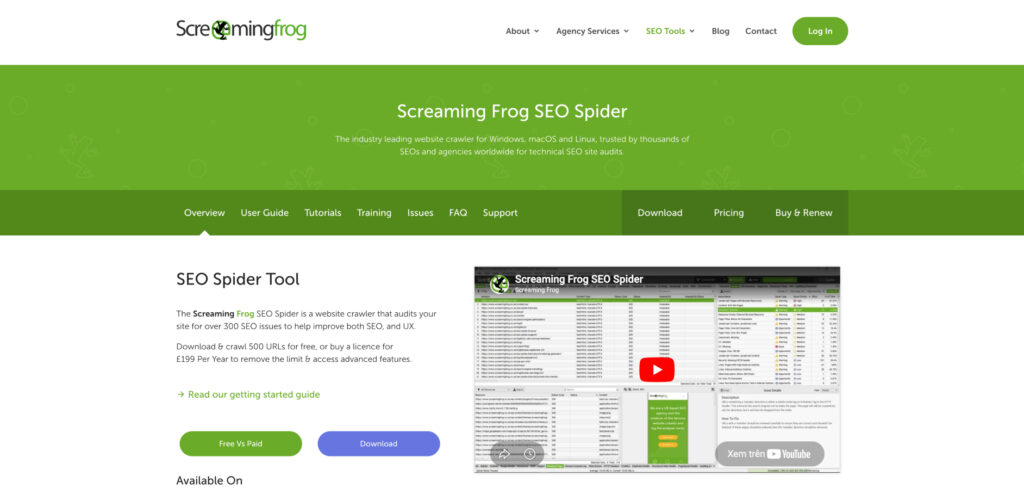
Pricing: Free up to 500 URLs · Paid license $259/yr (£199) per user · volume discounts at 5+, 10+, and 20+ licenses
Every technical audit an agency runs leans on a crawler, and Screaming Frog is the one most practitioners reach for. It surfaces the unglamorous but decisive issues — broken links, redirect chains, missing canonicals, thin titles, orphaned pages — and connects to Google Search Console, Analytics, and PageSpeed for richer context.
Its pricing model is refreshingly different in a market of monthly SaaS: a flat per-user annual license with unlimited local crawls and no per-crawl credits. For agencies running frequent audits across many client sites, that works out far cheaper than the crawl quotas baked into cloud tools.
It runs on your machine rather than in the cloud, so large crawls lean on your hardware, and the interface is built for SEOs rather than clients — you’ll export findings into your reporting tool rather than hand the app over. As a pure auditing workhorse, though, the value is hard to beat.
Consider Screaming Frog SEO Spider if:
Skip Screaming Frog SEO Spider if:
Analyzes top-ranking pages for a target term and gives writers real-time, color-coded guidance on terms, headings, and length — with team workflows that keep a roster of writers consistent.

Pricing: Essential $99/mo ($79/mo annual) · Scale $219/mo ($175/mo annual) · 7-day money-back guarantee
Surfer turns SERP analysis into a live score as writers work, which makes it easy to hand briefs to non-specialist freelancers and still get content that hits the marks correlated with ranking — and increasingly with being cited in AI answers. For agencies producing volume across many clients, that repeatability is the whole point.
Its Google Docs and WordPress integrations keep the workflow tight, shared workspaces let editors review against the same data, and the affordable entry tier plus optional AI drafting make it the most approachable serious content tool for most teams. As search rewards topical completeness over keyword stuffing, Surfer’s guidance pushes writers the right way.
For the deepest enterprise topical planning across thousands of pages you may still want Clearscope, and the subscription is hard to justify if you only optimize occasionally. But for a content team shipping regularly, it shortens the research-to-draft loop without sacrificing quality.
Consider Surfer SEO if:
Skip Surfer SEO if:
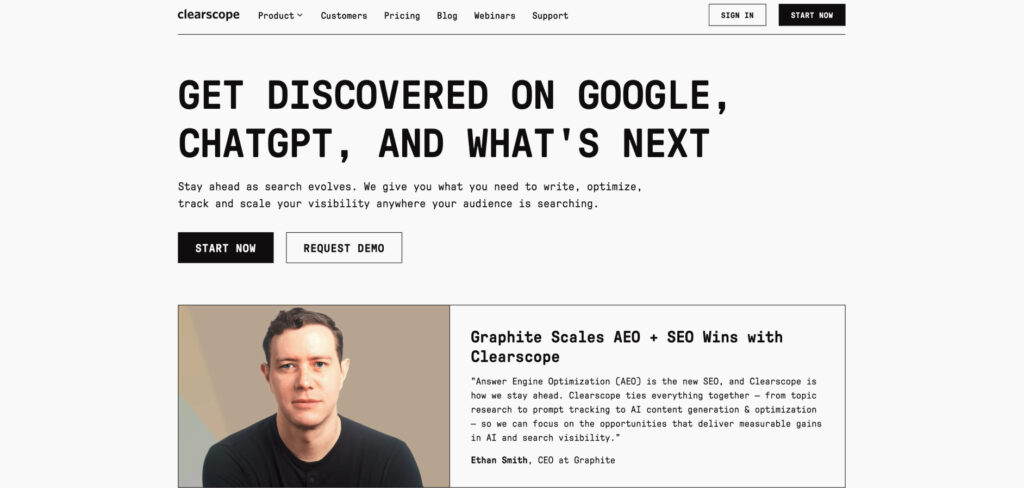
A premium, editorial-first content tool favored by large teams for its topical-map approach, clean collaboration, and excellent Google Docs integration.
Pricing: From $170/mo (Essentials) · higher tiers custom
Clearscope focuses on content intelligence rather than churning out drafts: it helps teams understand what makes a page rank and where a client’s topical authority has gaps. Its interface is clean, its Google Docs integration is excellent, and agencies handling editorial-quality content for demanding clients tend to prefer it when consistency matters more than raw volume.
In an AI-search world that emphasis on genuine topical depth pays off — comprehensive, authoritative pages are the ones models tend to cite. Clearscope won’t track AI mentions for you, but it’s a reliable way to build the kind of content that earns them across a portfolio of clients.
Consider Clearscope if:
Skip Clearscope if:
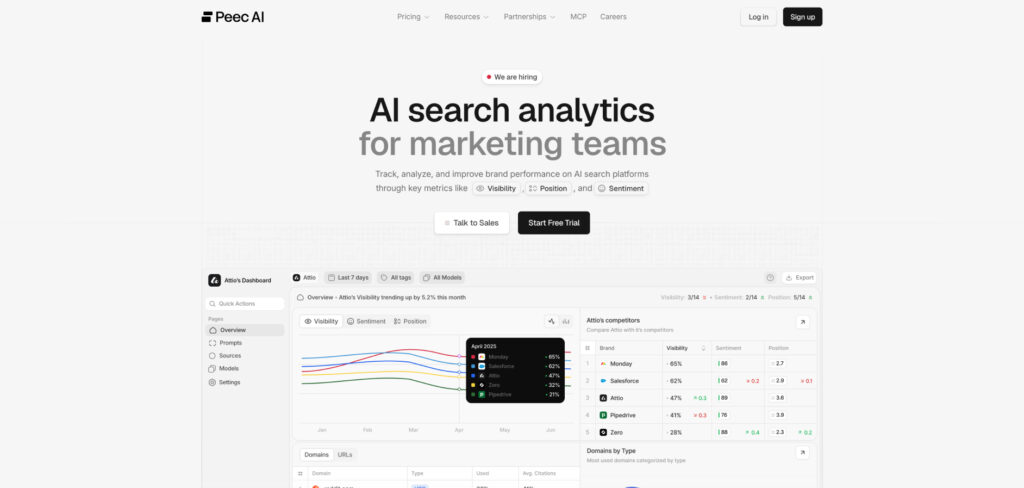
An analytics-first answer-engine tracker built with agencies in mind, pairing competitor benchmarking and a Looker Studio connector with Pitch Workspaces designed to win new business.
Pricing: From about €89/mo · higher tiers scale by prompts and engines · free trial available
As clients start asking where they show up in ChatGPT, Gemini, and Perplexity, agencies need a dedicated answer-engine tracker, and Peec has become the one mid-market shops keep shortlisting. Its interface is friendly, its competitor comparisons read cleanly, and its Pitch Workspaces are built specifically to help agencies win deals by putting a prospect’s AI visibility next to rivals’.
Under the hood it leans on UI scraping that simulates real user behavior rather than hitting APIs, which tends to mirror what an actual person sees in an AI answer. A Looker Studio connector pipes live visibility and source data into the dashboards teams already use, and smart suggestions propose the most relevant prompts and competitors to track per client.
Consider Peec AI if:
Skip Peec AI if:
Free, first-party data from Google on how every client site actually performs in search — now including impressions and clicks from AI features.
Pricing: Free
Every site an agency touches should be connected to Google Search Console, full stop. It’s the only tool that shows Google’s own view of a client’s pages — which queries they appear for, where they rank, and what’s blocking pages from being indexed. As Google folds AI Overviews and AI Mode into results, that performance data increasingly reflects AI-surfaced impressions too, giving you a free read on AI visibility.
It won’t track ChatGPT or Perplexity, and it won’t tell you why a model cites a client. But paired with the paid tools above it’s the foundation every report should be built on — and the first thing to set up on any new account before you spend a dollar.
Consider Google Search Console if:
Skip Google Search Console if: