
Every digital agency has some type of online presence. You have one even if you don’t have a website, active social media accounts, review platform listings, or freelance marketplace profiles. Today, everyone can find at least something about any business online.
So, it’s not a question of whether you need online presence management. It’s a question of whether you want to manage how your agency shows up in the digital world or have practically no influence over it.
This becomes even more important when you scale your business. Because when your agency grows, everything tends to grow around it. And it’s up to you whether you expand your brand authority or the confusion around your online presence.
In this guide, we’ll go beyond typical definitions and cover the most practical elements:
Online presence management (OPM) is all the activities you do to oversee and influence how your agency shows up in different digital channels. It’s about working with what you already have and moving to where you want your brand to be.
Many underestimate its importance. But it’s only because they miss the bigger picture: your online presence defines everything. Even when you start implementing your PR or digital marketing strategy, it won’t be as effective if your digital footprint and brand trust are off.
Let’s say now, people aren’t even sure what your agency does. Is it SEO? Branding? PPC? Or affiliate marketing? When your agency’s positioning is unclear, it’s much harder to trust you and nearly impossible to scale. And that’s what OPM can help you with.
Digital presence management helps you make sure people perceive you coherently, understand what you’re doing, and trust your brand.
What are the components of online presence management? Essentially, it’s everything you can find about your agency online, whether posted by you or not. These are some of the most obvious elements:
But there are also less obvious elements of your OPM that are much harder to control.
These are things like your ex-employee’s opinion in a LinkedIn comment section or your partner’s take in a random industry podcast. All those shape your brand. And if you aren’t entirely happy with what you see, you already know what your OPM strategy can focus on.
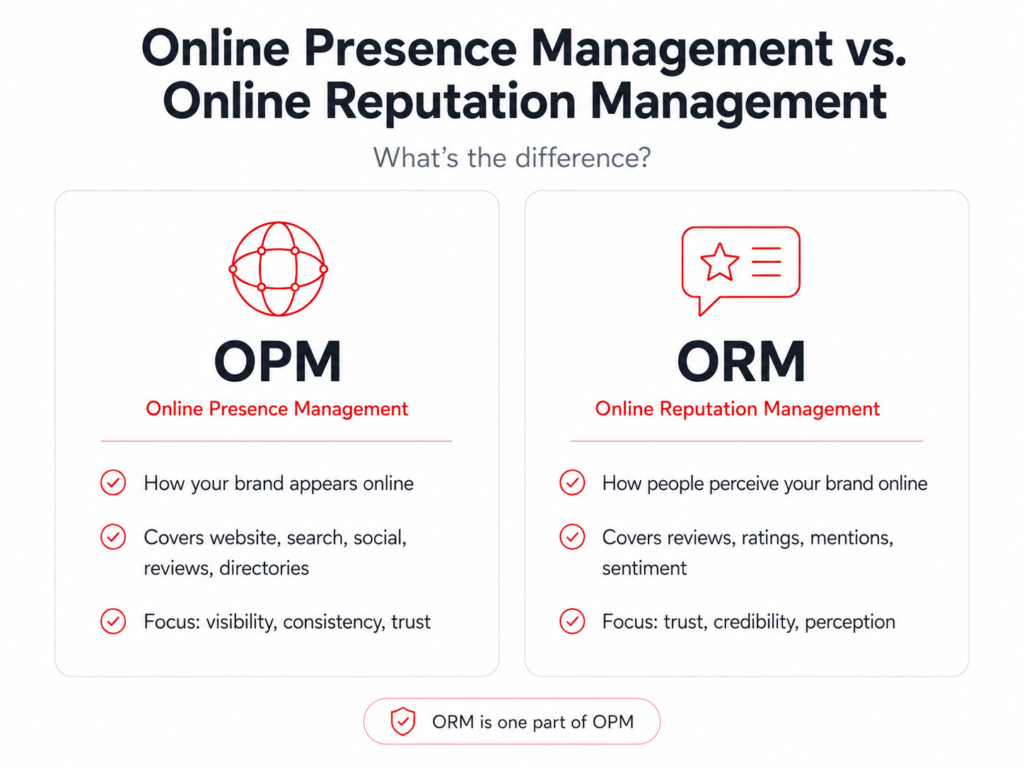
It’s common to confuse OPM with online reputation management. But these are different concepts. Reputation management is only one of the components of your entire digital presence management.
While reputational strategies come down to how people perceive your agency, OPM is much broader. It includes your reputation, positioning, trust, visibility, content, and dozens of other things that make up your entire digital footprint.
Consistency is the first thing that breaks when you scale without a system. Smaller agencies often get clients through their own network, some freelance platforms, word of mouth, and so on. They don’t necessarily need a massive digital footprint to stay busy. But once you decide to scale, the game changes. You’re no longer just competing with local freelancers; you’re competing with agencies across the globe. As your agency’s digital footprint expands across more platforms, you also become a bigger target for malicious traffic and fraudulent reviews, which often requires your technical team to know how to track an ip address to identify and block sources that could damage your brand’s hard-earned reputation.
That’s when many agencies start seriously thinking about their online discoverability and brand authority.
While you’re small and most of your clients come through referrals, you might not feel the competition that much. But once you need scalable agency lead generation, you have to make sure your brand actually differentiates itself compared to others. And that’s one of the OPM benefits.
It helps your agency to:
Essentially, when OPM is done properly, you get consistent brand visibility. And this creates a proper foundation for sustainable scaling.
So, that’s how online presence management helps digital agencies grow. Not by offering a quick fix or a magic pill. But by making sure that your agency’s online presence is solid enough to actually last in the long run.
Let’s see how to do OPM in a way that can actually help you scale your digital agency and achieve a more consistent brand image.
This isn’t about your mission and vision. You, as a digital agency, usually don’t need all those typical corporate approaches. What you do need, though, is a clear definition of:
These questions might seem too basic. But once you answer them in one sentence, you will know exactly what your positioning is. And this is the first step to building an actually effective online visibility strategy.
Now that you know how you want to be perceived, it’s time to check how you’re doing so far. Review all the content you’ve already posted online:
Do all those pieces communicate exactly what you came up with in Step 1? If so, congratulations! But most likely, you’ll still find some elements, topics, and angles that don’t feel like “you.” And this is your sign to adjust your strategy.
Because here is a thing: 71% of prospects do their own research instead of speaking to a sales team. So, what they find online is how they perceive you. And if the image they come up with is inaccurate, changing it would be much harder.
After reviewing your existing content, you might discover several surprising things that really need some tweaking. Overall, these are the major points to watch out for:
An effective digital presence management is largely about being consistent and having a well-balanced content strategy. One of the best ways to get there is by publishing pieces for each stage of the funnel:
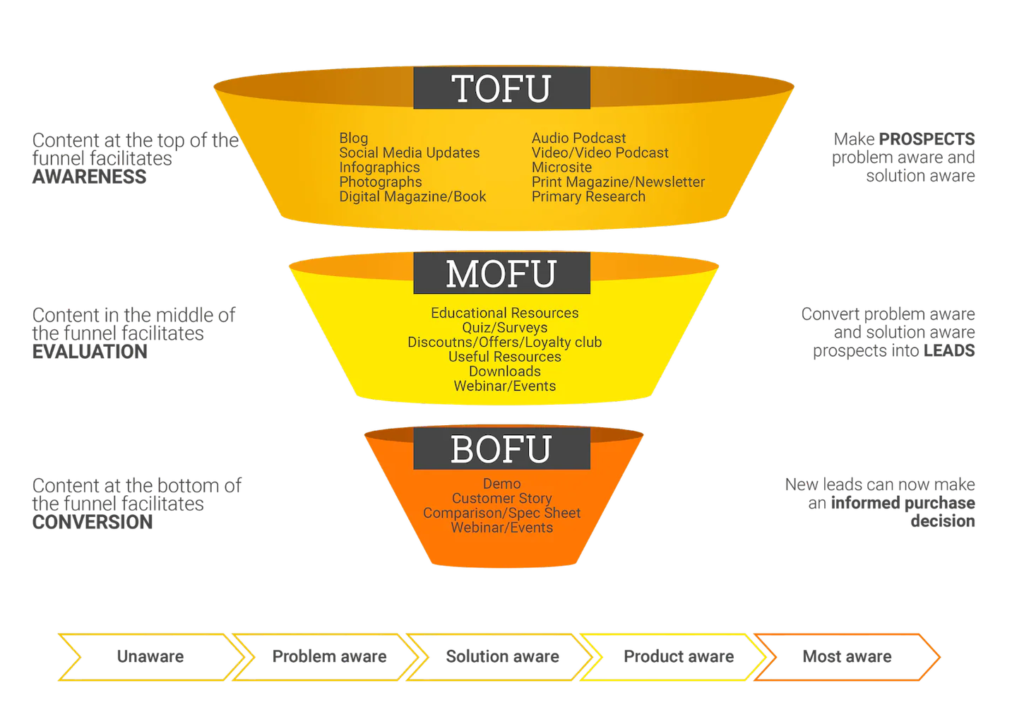
Source: Shopify
Practically, create a document with separate content ideas for ToFu, MoFu, and BoFu. It’ll be extremely helpful later on, as you can track how well each stage is addressed.
The more you work on your digital presence management, the more you see that it’s about cross-channel marketing.
Whether you like it or not, eventually, people will start sharing information about you across different channels. So, you can be one step forward and ensure multi-channel content distribution by yourself.
Still, it can be quite overwhelming unless you have an actual repurposing strategy:
The main goal is to create an easy process that takes as little time as possible. The most effort should go into the initial idea/message you want to communicate. The rest doesn’t matter as much.
With all the content ideas for different funnel stages and repurposing workflows, you might feel like getting that done is nearly impossible. That’s why you need a realistic schedule.
Sure, if you try to create and post all that content in a limited timeframe, you’ll simply burn out. But if you clearly define your priorities, it’ll get easier.
The simplest solution here is to:
You’ve probably noticed the pattern: one of the main OPM’s goals is to create a stronger brand. But unfortunately, online discoverability and a clear agency positioning alone won’t do that. That’s why you need to work on your brand trust and digital credibility.
Here is how you can do that: