
| Best for: Global enterprise brands, Fortune 500 companies, and multinational organizations that need end-to-end digital marketing transformation backed by the world’s largest technology consulting network.
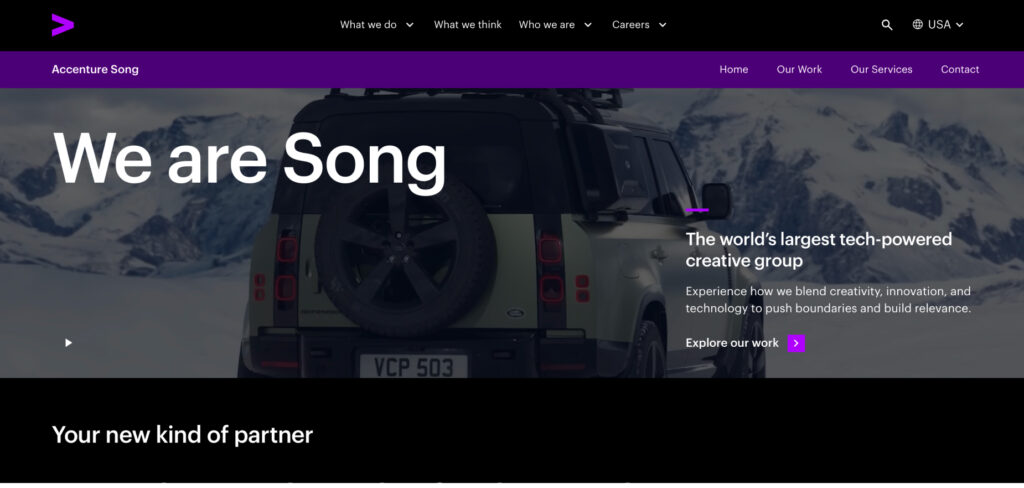
Accenture Song, the digital marketing and experience division of Accenture, operates at a scale virtually no other agency can match — over 60,000 practitioners across more than 120 countries. Formerly known as Accenture Interactive, Accenture Song combines the creative depth of a global agency network with the technology and data infrastructure of a management consultancy. Their enterprise digital marketing practice covers everything from strategy and media investment to content production, CX design, and performance analytics, all underpinned by Accenture’s proprietary AI and cloud capabilities. For brands seeking a single partner to manage digital marketing at global scale, Accenture Song is the definitive choice.
Services & Expertise
Integrated digital marketing, paid media, programmatic, SEO, CX transformation, content strategy, commerce, data and analytics, and marketing technology. Uniquely capable at enterprise MarTech stack integration and transformation.
Affordability
Enterprise-only pricing. Engagements are custom-scoped based on global remit, technology platforms, and campaign complexity. Not designed for mid-market budgets — built for organizations with seven-figure marketing investments.
Reviews & Reputation
Consistently ranked as the world’s largest digital marketing agency by Ad Age and Forrester. Trusted by some of the world’s most recognized brands including Unilever, Microsoft, and Maserati. Regularly named a Leader in Gartner’s Magic Quadrant for Marketing Agencies.
Case Studies & Results
Enterprise clients report 20–40% efficiency gains through integrated MediaTech and creative programs. CX transformation programs for global brands deliver measurable improvements in customer acquisition cost and lifetime value at scale.
Communication & Transparency
Dedicated global and regional account teams, executive-level steering committees, and real-time performance dashboards. Clients benefit from both creative leadership and operational rigor in all reporting structures.
| Best for: Large-scale advertisers and multinational brands that need sophisticated media planning, programmatic buying, and data-driven channel orchestration across every major digital and traditional media platform.
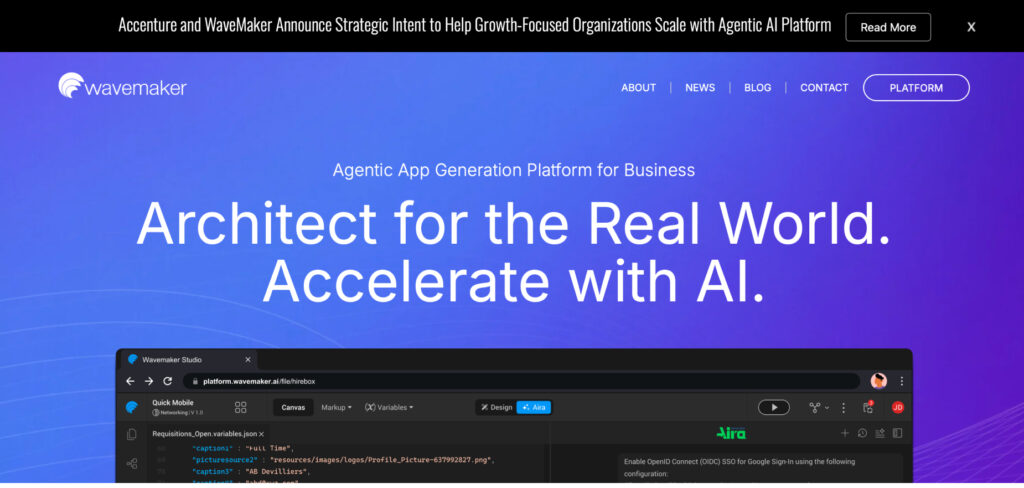
Wavemaker, part of the WPP network and one of the world’s largest media agencies with over $8 billion in billings, operates across 90 markets with a singular focus: turning media investment into business outcomes. Their Positive Provocation philosophy challenges conventions in media planning, combining audience intelligence, content strategy, and commerce media to find growth in underexplored channels. As a Google Marketing Platform Certified Partner and Meta Business Partner, Wavemaker’s enterprise clients benefit from early access to beta products and platform-level relationships that independent agencies simply cannot access. Their proprietary planning tools and attribution suite give marketing leaders a clear view of how media investment drives revenue growth.
Services & Expertise
Media planning and buying, programmatic, paid search, paid social, SEO, influencer marketing, content commerce, and advanced analytics. Exceptional cross-channel integration across traditional and digital media at scale.
Affordability
Enterprise pricing starting from $25,000/month for managed media programs. Retainer structures are determined by annual media investment volume, market scope, and integrated service requirements.
Reviews & Reputation
Multiple Cannes Lions Grand Prix winner. Ranked among the top global media agencies by RECMA. Strong client tenure rates and recognition across Effie, Warc, and Campaign awards for media effectiveness.
Case Studies & Results
Clients report 15–35% media efficiency improvements through programmatic consolidation and audience suppression. Commerce media programs consistently outperform industry benchmarks by 2–3x on ROAS for retail and CPG brands.
Communication & Transparency
Global reporting infrastructure, dedicated media leads, and quarterly business reviews with senior leadership. Proprietary dashboards provide unified view across all media channels and markets.
| Best for: Data-driven enterprise brands in financial services, insurance, healthcare, retail, and technology that require advanced CRM integration, customer identity resolution, and performance media tied directly to customer lifetime value.
Merkle, a dentsu company, is the enterprise agency that redefined performance marketing by putting customer data at the center of every media decision. With over 16,000 employees across 50+ countries, Merkle’s core competency lies in connecting offline CRM data with online media activation — enabling enterprise marketers to target, suppress, and message audiences based on true customer value rather than anonymous signals. Their People-Based Marketing framework, now a widely adopted industry standard they pioneered, allows brands to run paid search, programmatic, social, and email from a single customer identity graph. This capability is particularly powerful for regulated industries where audience precision directly affects acquisition efficiency and compliance.
Services & Expertise
Performance media (paid search, social, programmatic), CRM strategy, identity resolution, personalization, loyalty programs, analytics, MarTech implementation, and customer experience design.
Affordability
Mid-enterprise to enterprise pricing. Engagements typically begin at $15,000/month and scale significantly based on data infrastructure, media investment, and technology platform requirements.
Reviews & Reputation
Consistently ranked as a Leader in Forrester’s B2C Marketing Agencies Wave. Named a top performance marketing agency globally by Gartner. Strong reputation in financial services, healthcare, and retail for data-driven results.
Case Studies & Results
Financial services clients report 30–50% reduction in cost per new account through CRM-based suppression and LTV bidding. Retail clients achieve 2–4x ROAS improvement by connecting loyalty data to programmatic buying.
Communication & Transparency
Executive-level strategic reviews, cross-discipline team structures, and real-time analytics dashboards. Clients cite data transparency and attribution rigor as key differentiators versus traditional media agencies.
| Best for: Multinational enterprises and Fortune 500 brands that need a global integrated agency network managing paid media, programmatic, creative, and data intelligence across multiple markets simultaneously.

Dentsu is one of the world’s three largest advertising holding companies, operating a portfolio of enterprise media, creative, and technology agencies across 145 countries. Their enterprise digital marketing capabilities are delivered through a network of specialist brands including Carat, iProspect, Dentsu X, and Creative Line — each focused on distinct aspects of digital growth, from performance media to brand experience. What distinguishes Dentsu at the enterprise level is their integrated data platform: Dentsu’s proprietary M1 audience intelligence tool connects first-party, second-party, and third-party data to power media planning, programmatic buying, and measurement in a unified environment. For multinational brands managing complex media ecosystems, Dentsu provides the scale, technology, and local market expertise to deliver consistency across markets.
Services & Expertise
Paid media, programmatic, SEO, paid search, social, content, creative, CX, data and analytics, marketing technology, and commerce media. Full-service across all digital and traditional channels at global scale.
Affordability
Enterprise and custom pricing. Global remit engagements are scoped based on market count, channel mix, and technology requirements. Individual market engagements begin at $10,000–$15,000/month.
Reviews & Reputation
Ranked among the top three global advertising holding companies. Multiple Cannes Lions and Effie Worldwide winners. Trusted by Toyota, Panasonic, Nestlé, and hundreds of multinational brands. Consistent rankings across RECMA and Forrester.
Case Studies & Results
Global enterprise clients report 20–40% improvement in media efficiency through consolidated buying and M1 audience activation. Cross-market campaigns deliver measurable brand equity and performance metrics simultaneously.
Communication & Transparency
Global account leadership teams, market-level management, and unified reporting frameworks. Clients benefit from both global strategic oversight and local market execution transparency.
| Best for: Enterprise and high-growth brands that need a rigorous, data-science-driven approach to paid search, paid social, and programmatic — with a track record of outperforming incumbent agencies through systematic testing and algorithmic optimization.
Brainlabs, founded in 2012 by two former Google engineers, has built one of the most technically sophisticated performance marketing agencies in the world. Their foundational philosophy — that every media decision should be testable, measurable, and improvable through statistical rigor — distinguishes them from both traditional media agencies and conventional digital shops. Brainlabs’ proprietary technology stack includes custom bidding algorithms, audience testing frameworks, and automated reporting infrastructure that enables their team to run hundreds of concurrent experiments across client accounts. With over 1,000 employees across offices in New York, London, Chicago, and 16 other global markets, Brainlabs manages over $1 billion in annual media spend. Their enterprise clients include the BBC, Canon, and major Fortune 500 technology and retail brands.
Services & Expertise
Paid search, paid social, programmatic display, SEO, analytics, data science, CRO, and marketing attribution. Proprietary testing infrastructure sets them apart in enterprise paid media management.
Affordability
Upper mid-market to enterprise pricing. Retainers typically begin at $10,000/month and scale based on media investment volume and markets managed. Mid-market clients accepted where complexity justifies engagement.
Reviews & Reputation
Multiple industry awards including Campaign, The Drum, and US Search Awards. Strong Clutch profile and consistently cited as one of the top performance marketing agencies globally. High client tenure and retention.
Case Studies & Results
Enterprise clients report 20–50% efficiency improvements within six months through algorithmic bidding and systematic testing. Cross-channel attribution programs uncover meaningful incremental media investment opportunities for scaling brands.
Communication & Transparency
Weekly performance reporting, dedicated strategists, and custom analytics dashboards. Known for scientific transparency — clients receive full visibility into test design, statistical significance, and methodology behind every optimization.
| Best for: Enterprise eCommerce, DTC, and retail brands that need a specialist agency managing the full digital shelf — from Google and Meta to Amazon, retail media networks, and Connected TV — with unified measurement across every channel.
Tinuiti has established itself as the dominant independent performance marketing agency for enterprise commerce brands, managing over $4 billion in annual media spend across the channels that matter most for retail and DTC growth. Their Total Commerce approach combines paid search, shopping, Amazon advertising, Walmart Connect, Instacart, streaming TV, and paid social into a single integrated strategy — with attribution modeling that shows exactly how each channel contributes to revenue. Their proprietary Bliss Point technology platform powers audience modeling, incrementality testing, and cross-channel budget optimization in real time. With 1,200+ employees and offices across six U.S. cities, Tinuiti is the agency of choice for brands like Bombas, Etsy, and Brooks Running that need enterprise-grade media expertise without the bureaucracy of a holding company.
Services & Expertise
Paid search, Google Shopping, Amazon Ads, retail media networks, Meta and Pinterest advertising, Connected TV, streaming audio, SEO, email, and proprietary Bliss Point analytics platform.
Affordability
Enterprise pricing starting at $10,000/month. Retainer structures are determined by channel mix, media investment volume, and technology platform requirements. Accessible relative to holding company agencies.
Reviews & Reputation
Ranked #1 independent performance marketing agency by Forrester. Google Premier Partner, Amazon Advertising Partner, and Meta Business Partner. Named to Inc. 5000 and Adweek Agency 100. Strong Clutch and G2 profiles.
Case Studies & Results
eCommerce clients report 30–60% revenue growth through Amazon and retail media expansion. DTC brands achieve 2–4x improvement in blended ROAS after cross-channel media consolidation. Incrementality testing reveals 15–25% revenue uplift from streaming TV programs.
Communication & Transparency
Bliss Point dashboards, dedicated account teams, quarterly business reviews, and proactive budget reallocation recommendations. Clients consistently cite measurement transparency as a core differentiator versus holding company alternatives.
| Best for: Global enterprise brands and technology companies that need a sophisticated marketing operations partner combining paid media, SEO, creative production, and data intelligence with deep Google ecosystem expertise.
Jellyfish has become one of the most significant independent enterprise digital agencies in the world, with over 2,000 employees across 40+ global offices and backing from Fimalac Group. What distinguishes Jellyfish is their position as a strategic partner to Google — providing training, certification programs, and marketing intelligence directly endorsed by the platform. Their enterprise clients benefit from a uniquely deep relationship with Google’s product teams, giving them early access to new features, beta products, and first-party platform insights. Jellyfish’s integrated model combines performance media (paid search, programmatic, paid social), SEO, creative services, and data engineering under a single client team — eliminating the fragmentation that plagues most enterprise agency relationships. Clients include Uber, eBay, Samsung, and hundreds of global enterprise brands.
Services & Expertise
Paid search, paid social, programmatic, SEO, creative strategy and production, data engineering, marketing analytics, and enterprise training. Unique positioning as a Google-endorsed training partner gives enterprise clients a competitive intelligence advantage.
Affordability
Enterprise pricing starting at $12,000/month for integrated programs. Full-service global engagements are scoped based on channel mix, market footprint, and creative production requirements.
Reviews & Reputation
Official Google Partner Academy provider. Multiple Campaign, Drum, and Search Awards honors. Widely recognized as one of the top independent digital agencies globally. Strong retention among Fortune 500 enterprise clients.
Case Studies & Results
Enterprise technology clients report 25–40% reduction in cost per install through advanced audience segmentation and Performance Max optimization. Global eCommerce brands achieve consistent revenue uplift through unified search and shopping strategies.
Communication & Transparency
Integrated client teams with media, creative, and data specialists. Regular performance reviews, proprietary reporting dashboards, and direct access to Google platform specialists for advanced campaign troubleshooting.
| Best for: Mid-market to enterprise brands in eCommerce, B2B technology, and financial services that need rigorous performance marketing grounded in first-party data activation, predictive analytics, and full-funnel measurement.
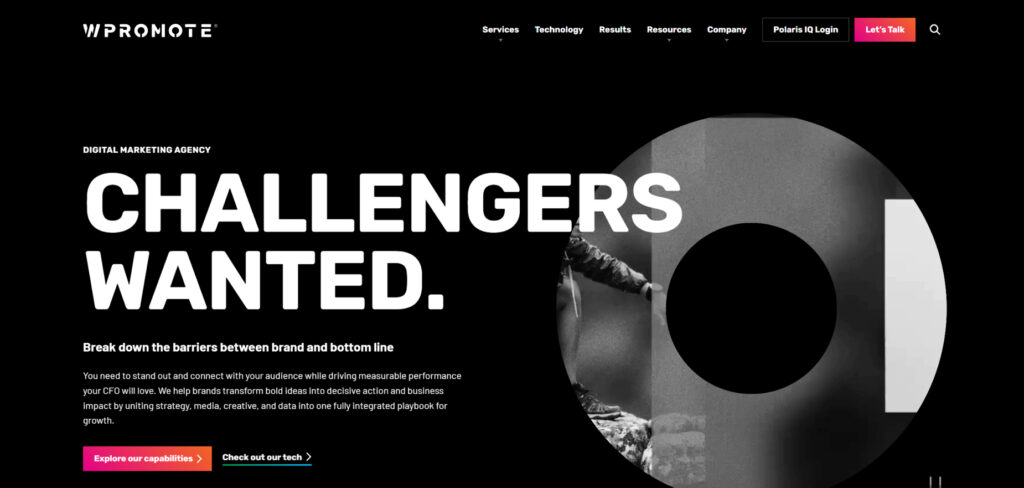
Wpromote, founded in 2001 and headquartered in El Segundo, California, has grown into one of America’s leading independent performance marketing agencies — managing over $2 billion in annual media spend and consistently recognized as a top agency by Forrester, Inc. 5000, and industry awards programs. Their Think Like a Challenger philosophy drives an approach where every client, regardless of size, is treated as a growth-stage brand: aggressively testing, iterating, and finding competitive advantages that larger incumbents overlook. Wpromote’s proprietary Polaris BI platform unifies first-party data, media performance, and attribution modeling into a single intelligence layer — enabling enterprise clients to make faster, better-informed budget decisions across paid search, paid social, SEO, and email. Enterprise clients include Adobe, Whirlpool, and LinkedIn.
Services & Expertise
Paid search, paid social, programmatic, SEO, content marketing, email automation, analytics, and the proprietary Polaris BI platform. Strong integration between channel teams and data science creates a unified performance view.
Affordability
Mid-enterprise to enterprise pricing. Retainers start at $8,000/month and scale with media investment and service scope. More accessible than holding company agencies while delivering comparable analytical depth.
Reviews & Reputation
Forrester Contenders ranking in Performance Marketing Agencies. Multiple Inc. 5000 inclusions, US Search Award winner, and Google Premier Partner. High client retention and strong Clutch reviews across enterprise verticals.
Case Studies & Results
B2B technology clients report 40–70% increase in pipeline contribution from paid search within six months. eCommerce clients achieve consistent ROAS improvements through Polaris-driven audience suppression and lookalike expansion.
Communication & Transparency
Polaris dashboards, weekly performance reviews, dedicated account teams, and quarterly strategic planning sessions. Known for proactive attribution modeling and transparent budget recommendation processes.
| Best for: Enterprise and Fortune 500 brands that need a global creative and digital marketing partner delivering brand-connected performance — where data-driven media investment is inseparable from the creative and customer experience strategy that drives it.

VML, formed from the merger of VMLY&R and Wunderman Thompson (both WPP companies) in 2024, is now one of the world’s largest integrated creative and performance marketing agencies — with over 30,000 people across 150 offices in 64 markets. This merger created a uniquely powerful enterprise offering: the brand-building depth of Y&R, the digital performance expertise of Wunderman, and the CX and commerce capabilities of VML all under one roof. VML’s enterprise clients benefit from an agency that can design a brand platform on Monday and optimize the performance campaigns amplifying it by Friday. Their proprietary enterprise MarTech solutions — spanning CRM, loyalty, digital commerce, and marketing automation — make VML the partner of choice for brands that cannot afford the disconnection between creative vision and performance execution.
Services & Expertise
Brand strategy and creative, digital marketing, paid media, CX design, commerce, loyalty programs, CRM, content production, and marketing technology. One of the few agencies capable of managing both enterprise brand and performance mandates simultaneously.
Affordability
Enterprise and custom pricing based on scope, market footprint, and service mix. Global integrated engagements are among the largest in the industry. Regional and market-level engagements available from $15,000/month.
Reviews & Reputation
Multiple Cannes Lions Grand Prix wins, D&AD Pencils, and Effie Gold awards. WPP’s flagship creative and experience agency post-merger. Trusted by Ford, Wendy’s, Colgate-Palmolive, and hundreds of global enterprise brands.
Case Studies & Results
Commerce transformation programs deliver 30–60% revenue growth for enterprise retail clients. Integrated brand and performance programs consistently outperform split-agency models on both brand equity and CAC metrics.
Communication & Transparency
Global account leadership, integrated creative-performance team structures, and enterprise-grade reporting infrastructure. Clients cite the elimination of agency handoffs as a key operational improvement versus multi-agency models.
| Best for: Enterprise B2B brands, professional services firms, and corporations that need digital marketing and communications strategies that align paid performance with earned authority — building trust at scale through thought leadership, content, and integrated campaigns.
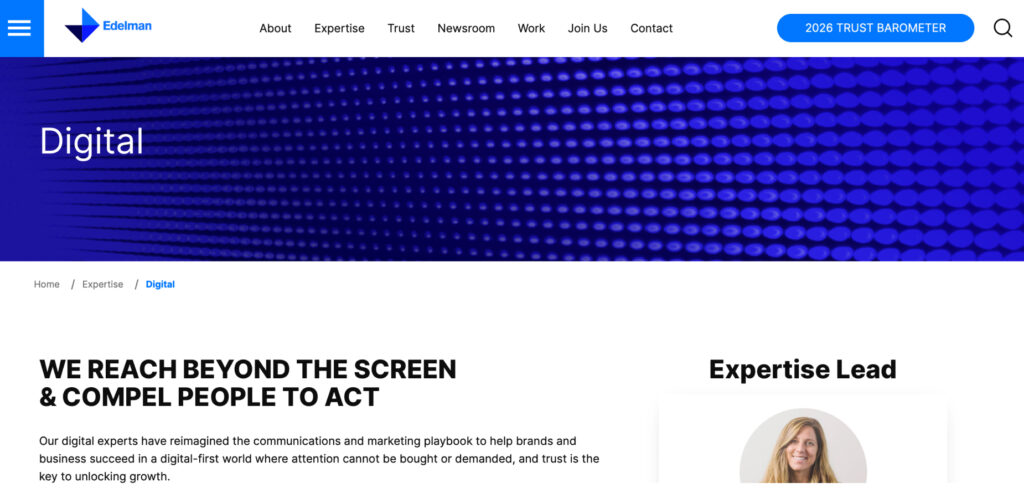
Edelman Digital, the digital and marketing arm of the world’s largest independent public relations firm, occupies a unique position in the enterprise marketing landscape: they are the only agency that combines the earned media authority of a global PR powerhouse with the paid performance capabilities of a full-service digital agency. With over 6,000 employees across 60 countries and 70 years of trust-building expertise, Edelman brings a fundamentally different philosophy to enterprise digital marketing — one where brand credibility, executive visibility, and thought leadership are treated as measurable performance assets, not soft intangibles. Their integrated model allows enterprise clients to run paid search and social campaigns that are amplified by simultaneously executed earned content and influencer programs — creating a compounding effect on visibility and conversion that pure performance agencies cannot replicate.
Services & Expertise
Digital strategy, paid media, SEO, content marketing, thought leadership programs, influencer marketing, social media management, earned media integration, analytics, and marketing communications. Unique capability in integrating paid performance with earned authority.
Affordability
Enterprise pricing from $15,000/month for integrated digital programs. Scope-based engagements for global communications and marketing mandates are custom-structured based on market coverage and channel mix.
Reviews & Reputation
World’s largest independent PR and communications agency. Named a Leader in Forrester’s B2B Marketing Agencies Wave. Trusted by Samsung, Unilever, HP, Johnson & Johnson, and hundreds of global enterprise brands. Consistent Cannes PR Lions and Effie winner.
Case Studies & Results
B2B technology clients report 3–5x increase in organic share of voice within 12 months through integrated paid and earned strategies. Enterprise brands achieve measurable improvements in C-suite consideration metrics when thought leadership is integrated with performance media.
Communication & Transparency
Integrated communications and digital teams, executive-level advisory relationships, and real-time analytics dashboards. Clients cite the convergence of reputation management and performance reporting as a unique value of Edelman’s model.