

| Best for: Full-service eCommerce brands, multi-location retailers, and DTC companies that need a comprehensive content marketing strategy backed by two decades of SEO expertise, technical depth, and cross-channel execution.
Thrive Internet Marketing Agency, founded in 2005 and headquartered in Arlington, Texas, is one of the longest-standing and most decorated eCommerce content marketing agencies in the U.S. With a team of 200+ specialists, Thrive has spent nearly two decades refining what works across organic search, content production, email marketing, and paid amplification for online retailers. Their eCommerce content marketing practice is built on a foundational belief that content must serve buyers at every stage of the funnel — from product discovery through post-purchase retention. Every engagement begins with a deep technical SEO audit and competitive content gap analysis before a single piece of content is commissioned, ensuring production effort is directed where organic opportunity is highest.
Services & Expertise
Full content marketing stack: SEO content strategy, blog production, product page optimization, category page content, email marketing, video production, social content, and CRO. Particularly strong in multi-location eCommerce and Amazon content strategy.
Affordability
Mid-range pricing accessible to growing brands. Monthly retainers typically start at $1,500 and scale with content volume and channel scope. Strong ROI potential for brands willing to invest in 6–12 month content programs.
Reviews & Reputation
300+ verified Clutch reviews with a 4.9/5 average. Named a top digital marketing agency by Clutch, UpCity, and multiple industry publications. Consistent recognition for client communication and measurable content results.
Case Studies & Results
eCommerce clients report 200–400% organic traffic growth within 12 months of engagement. DTC brands in fashion and home goods achieve consistent revenue attribution from content channels within 6 months.
Communication & Transparency
Dedicated account managers, bi-weekly performance reviews, and custom analytics dashboards tracking content-attributed revenue. Clients consistently cite responsiveness and reporting clarity as standout qualities.
| Best for: Ecommerce brands with large product catalogs, DTC companies, and retailers that need high-volume, design-rich SEO content paired with aggressive link acquisition to dominate category and comparison search results.
Siege Media, founded in 2012 and headquartered in San Diego, California, has built one of the most recognized content marketing brands in the industry by solving a problem most agencies ignore: content that ranks but never earns links. Their model integrates editorial production with custom graphic design and digital PR, creating assets that simultaneously drive search rankings and attract organic backlinks. For eCommerce brands, this means category-level blog content paired with link-worthy comparison guides, interactive tools, and data-driven industry reports. Their client portfolio spans major DTC and retail brands including Zillow, Shutterfly, and TripAdvisor, and their team has generated over $148 million in yearly client traffic value.
Services & Expertise
SEO content strategy, blog production, content design (infographics, comparison assets, interactive tools), link building, digital PR, and website UX consultation. Particularly strong in creating linkable assets for competitive eCommerce categories.
Affordability
Mid-to-upper tier pricing. Monthly retainers typically begin at $3,000 and scale with content volume and design complexity. Premium is justified by integrated design and link acquisition — capabilities that most content-only agencies cannot replicate.
Reviews & Reputation
Recognized as a top content marketing agency by multiple industry publications. Strong Clutch and G2 profiles. Frequently cited by eCommerce operators for exceptional content design quality and link velocity.
Case Studies & Results
Clients report 50–150% organic traffic increases within 9 months. Link acquisition campaigns deliver 30–80 high-authority backlinks per quarter for competitive eCommerce categories. Content design assets consistently earn unsolicited coverage from industry publications.
Communication & Transparency
Dedicated content strategists and editorial leads. Monthly reporting on traffic, rankings, and link acquisition. Clients appreciate the visual quality of reporting materials and the clarity of strategy documentation.
| Best for: DTC eCommerce brands, VC-backed consumer companies, and growth-stage online retailers that need content marketing integrated with performance creative, UGC production, and paid amplification to break through plateau growth.
NoGood, headquartered in New York City, has built its eCommerce content marketing practice around a creative-first, experiment-driven thesis: in 2026, content velocity and creative quality are the primary levers separating growing DTC brands from stagnating ones. Their team of ‘growth scientists’ treats every content program as a structured experiment — developing hypotheses about what resonates with target buyers, producing content across formats, measuring conversion impact, and systematically scaling what works. NoGood’s in-house creative team produces UGC-style content, direct-response video, editorial assets, and static creative simultaneously, using performance data to determine what gets produced next. Their client roster includes VC-backed consumer brands and established eCommerce players in fashion, health and wellness, and consumer tech.
Services & Expertise
Growth-led content marketing, UGC production, paid social creative, SEO content, video content, brand storytelling, influencer strategy, and performance analytics. Unique integration of content production with paid amplification and CRO.
Affordability
Mid-to-enterprise pricing. Retainers typically begin at $5,000/month for full-service growth content programs. Best ROI for brands with meaningful content distribution budgets alongside production.
Reviews & Reputation
Strong Clutch and Glassdoor profiles. Frequently named a top growth marketing agency by leading publications. Clients praise creative quality, experimental rigor, and the measurability of content programs.
Case Studies & Results
DTC clients report 3–5x content-driven revenue attribution improvements within 6 months. UGC content campaigns consistently outperform traditional brand creative by 40–80% on engagement and conversion metrics.
Communication & Transparency
Sprint-based content reviews, Slack-integrated communication, and growth dashboards linking content performance to revenue metrics. Clients describe NoGood as a strategic partner rather than a content vendor.
| Best for: Direct-to-consumer eCommerce brands generating $1M–$15M annually in fashion, baby, home goods, and lifestyle categories that need search-channel content ownership across organic, paid, and AI-generated results.
Stryde, founded in 2013 and headquartered in Utah, is one of the most intentionally focused eCommerce content marketing agencies on this list. Rather than offering a sprawling suite of services, Stryde has deliberately narrowed its practice to the three channels it believes deliver the highest compounding, sustainable growth for D2C brands: SEO content marketing, Google Ads, and AI Search Optimization (AEO/GEO). This focused model means every strategy, every content piece, and every optimization is calibrated specifically for brands selling physical products directly to consumers online. Founder Greg Shuey brings over 20 years of eCommerce search marketing experience, and the agency’s content playbooks have been refined across hundreds of DTC brands. For brands that have exhausted basic paid advertising and need a systematic approach to search-driven content growth, Stryde offers focused expertise that generalist agencies simply cannot replicate.
Services & Expertise
eCommerce SEO content strategy, blog production, category page optimization, buying guide creation, AEO/GEO content for LLM visibility, Google Ads, and content-based link acquisition. Deep specialization in D2C consumer product categories.
Affordability
Accessible mid-market pricing. Monthly retainers typically start at $2,000 and scale with content volume. Exceptional value for the depth of eCommerce content specialization delivered relative to price.
Reviews & Reputation
Strong Clutch and Google review profiles. Frequently cited in eCommerce marketing publications as a top content and SEO agency for D2C brands. Clients consistently praise niche expertise and content strategy quality.
Case Studies & Results
D2C clients in fashion and home goods report 150–300% organic traffic growth over 12-month content programs. AEO-focused content initiatives generate measurable LLM citation appearances for client brands within 6 months.
Communication & Transparency
Weekly optimization updates, content performance dashboards, and regular strategy reviews. Clients describe the team as highly accessible and consistently proactive in surfacing content opportunities.
| Best for: Mid-market eCommerce brands, online retailers in healthcare and travel, and DTC companies that need award-winning content marketing backed by rigorous testing, real-time data, and direct strategist access — not account manager handoffs.

Inflow, founded in 2007 and headquartered in Denver, Colorado, has spent nearly two decades building a reputation as one of the most client-centric eCommerce content marketing agencies in the U.S. Their defining model is unusual for an agency: every client receives direct access to the senior strategists managing their account — no junior account managers, no hand-offs. This structure means the people developing content strategy are also the people executing and optimizing it, creating accountability loops that most agencies structurally cannot offer. Inflow’s content marketing practice is grounded in conversion rate optimization, meaning every content asset is designed not just to attract traffic, but to progress buyers toward purchase. Their testing culture — running structured content experiments to validate strategy before scaling investment — gives clients confidence that content programs are built on data rather than assumptions.
Services & Expertise
eCommerce content strategy, SEO content production, CRO-integrated content, paid search, paid social, email/SMS marketing, and digital marketing consulting. Particularly strong in content testing frameworks and attribution modeling.
Affordability
Mid-market pricing reflecting senior-team access. Monthly retainers typically start at $3,000. Higher than budget agencies but justified by direct strategist access and the conversion-optimization layer applied to every content asset.
Reviews & Reputation
Award-winning agency with consistent 5-star reviews across Clutch and Google. Clients frequently cite 3x revenue growth during multi-year engagements. Recognized as a top eCommerce marketing agency by multiple industry publications.
Case Studies & Results
eCommerce clients report 3x revenue growth over multi-year content program engagements. Healthcare and travel clients achieve consistent CPA reductions of 30–50% through content-driven organic traffic substitution for paid spend.
Communication & Transparency
Direct access to senior strategists, detailed monthly reporting, and performance dashboards. Clients consistently praise communication quality and the strategic depth of account managers as primary differentiators.
| Best for: Enterprise eCommerce stores, large Shopify and Magento operations, and multi-category retailers that need technical SEO content architecture combined with revenue-driven category page strategies to dominate high-volume product search queries.
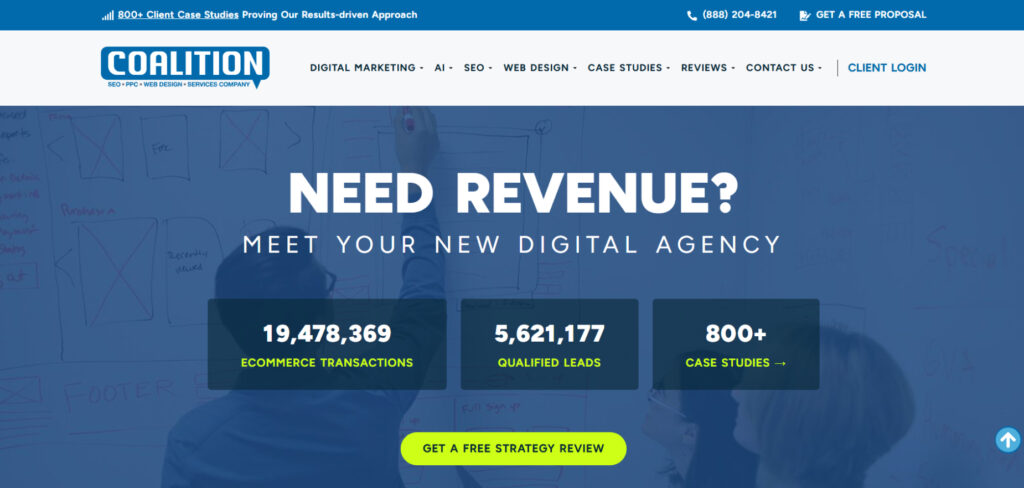
Coalition Technologies, founded in 2009 and headquartered in Los Angeles, California, has established itself as one of the most technically rigorous eCommerce content marketing agencies operating at scale. Their approach centers on a ‘hub-and-spoke’ content model where core category pages are supported by detailed comparison guides, intent-driven FAQs, and structured buying guides — all engineered with schema markup, internal linking architecture, and conversion-optimized copy. Rather than treating content as standalone blog posts, Coalition builds content systems that make entire category trees more visible and more valuable. Their 200+ person team includes dedicated SEO strategists, content writers, web developers, and UX designers who collaborate on campaigns — ensuring content strategy is executable within the client’s technical infrastructure, whether Shopify, Magento, or custom platforms.
Services & Expertise
Category page SEO content, hub-and-spoke content architecture, blog production, schema markup, technical SEO, Shopify/Magento development, paid search, and CRO. Particularly strong in large-catalog eCommerce content strategy and technical implementation.
Affordability
Accessible entry-level pricing for the technical depth delivered. Monthly retainers start around $1,500 and scale with catalog size and content volume. Strong ROI potential for large-catalog retailers where category content improvements compound across thousands of pages.
Reviews & Reputation
Clutch Top Agency recognition with 300+ verified reviews. Clients in retail, fashion, and consumer electronics consistently cite revenue-attributable content results. Strong reputation for technical content execution that other agencies cannot match.
Case Studies & Results
Enterprise eCommerce clients report 200–500% organic revenue increases within 18 months of category content program implementation. Large-catalog retailers achieve measurable ranking improvements across thousands of product and category pages simultaneously.
Communication & Transparency
Dedicated account managers, weekly performance calls, and technical reporting dashboards. Clients appreciate the depth of technical documentation and the transparency of content architecture decisions.
| Best for: Enterprise and mid-market eCommerce brands that need a globally scalable content marketing partner capable of building organic moats through full-funnel content ecosystems, authority-driven SEO, and AI-era answer engine optimization.
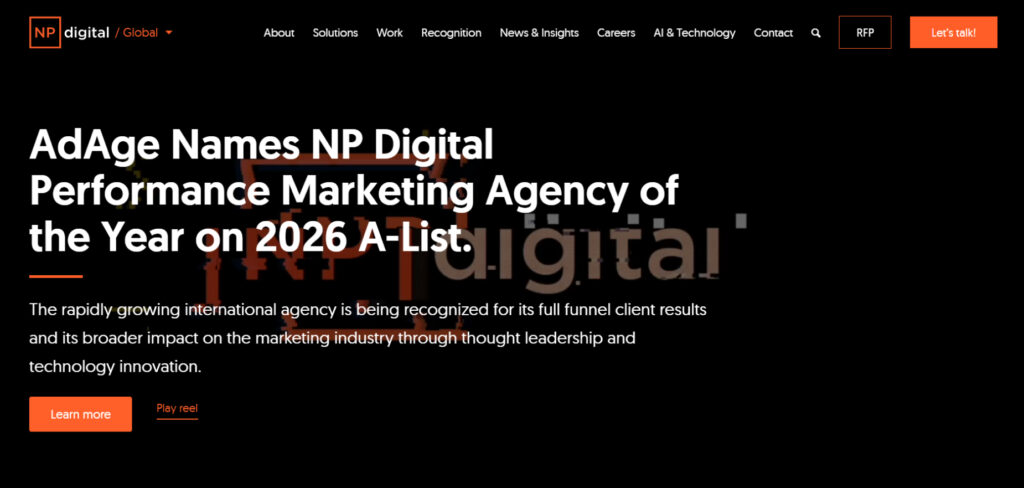
NP Digital, co-founded by Neil Patel and headquartered in Las Vegas, Nevada, has grown into one of the largest and most globally recognized content marketing agencies in the world. Their eCommerce content marketing practice is built on the premise that paid media costs will continue escalating indefinitely — making the organic content moat one of the few sustainable competitive advantages available to online brands. NP Digital doesn’t produce standalone blog posts; they build entire content ecosystems using a hub-and-spoke model where high-value pillar pages are supported by intent-mapped supporting content, video, and social amplification. Their AEO (Answer Engine Optimization) practice, which they frame as entity-first optimization, makes client brand information consistent and authoritative enough across the web that LLMs including ChatGPT, Perplexity, and Google AI Overviews treat it as a trusted source for eCommerce queries. Proprietary tooling through Ubersuggest underpins their research and content gap analysis across every engagement.
Services & Expertise
SEO content ecosystems, AEO/entity optimization, paid search, paid social, email marketing, influencer marketing, CRO, and analytics. Global delivery capability with local market expertise across North America, Europe, and Asia-Pacific.
Affordability
Enterprise and mid-market pricing. Monthly retainers typically begin at $5,000 and scale significantly for global campaigns. Best suited for brands with meaningful organic content investment budgets. Smaller brands may find the engagement model oversized for early-stage needs.
Reviews & Reputation
One of the most recognized names in digital content marketing globally. Clutch Top Agency, multiple Advertising Age and Search Engine Land recognitions. Clients include Levi’s, B&Q, and National Transport Services. Strong but variable review profiles reflecting rapid growth through acquisition.
Case Studies & Results
Enterprise eCommerce clients report 3–10x organic traffic growth within 18-month content programs. AEO-optimized brands achieve consistent citation appearances across LLM platforms, generating measurable brand awareness in AI-driven search environments.
Communication & Transparency
Dedicated strategists, executive review cadences, and proprietary Ubersuggest-powered reporting dashboards. Content programs include clear attribution modeling linking content investment to revenue outcomes. Best-in-class reporting for enterprise accounts.
| Best for: Ecommerce brands, DTC companies, and online retailers that are tired of content programs that drive traffic without revenue — and need a partner that builds every content strategy backward from conversion intent rather than search volume.
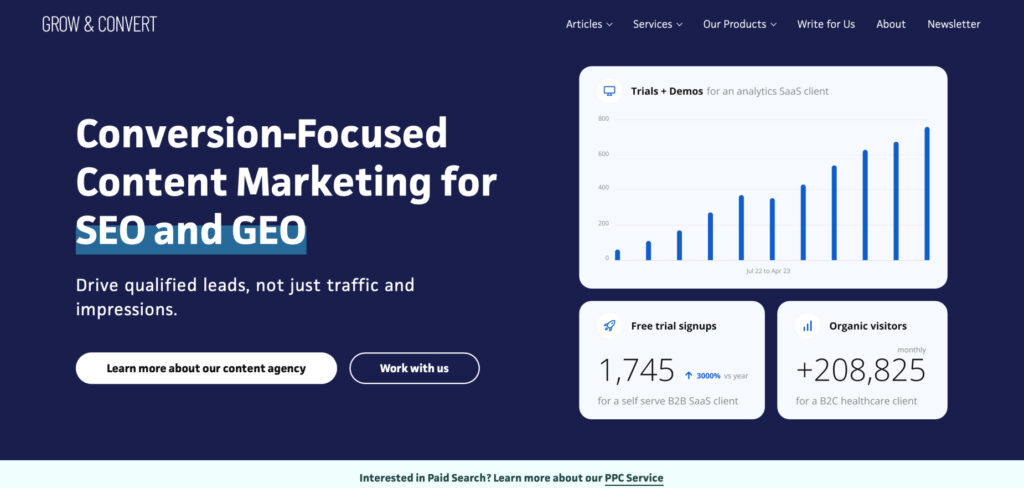
Grow and Convert, founded in 2015 and headquartered in San Francisco, California, has built one of the most distinctive content marketing methodologies in the industry by rejecting the conventional belief that content success equals more traffic. They coined the term ‘Pain Point SEO’ — a content strategy framework that deliberately targets bottom-of-funnel search queries where buyers are actively comparing solutions and ready to make purchasing decisions, rather than top-of-funnel informational queries that generate impressions but rarely convert. For eCommerce brands, this means a content architecture designed to intercept buyers at the exact moment they are choosing between products or seeking the specific solution the brand offers. Every content strategy begins with buyer research rather than keyword research — understanding what pain points drive purchase intent before determining which terms to target.
Services & Expertise
Pain Point SEO, conversion-focused content strategy, BOFU (bottom-of-funnel) blog production, content-to-pipeline attribution, content gap analysis, and digital analytics. Uniquely specialized in revenue-attributable content programs for brands with defined conversion goals.
Affordability
Mid-to-upper pricing reflecting the strategic depth of their methodology. Monthly retainers typically start at $3,500 and scale with content volume and market complexity. Premium is justified by conversion focus — programs generate qualified buyer traffic rather than general awareness.
Reviews & Reputation
Widely cited in the content marketing industry as pioneers of conversion-intent content strategy. Strong client review profiles across Clutch and LinkedIn. Recognized by major marketing publications for methodology innovation and measurable client outcomes.
Case Studies & Results
eCommerce clients report 40–120% increases in content-attributed conversions within 12 months. Comparison and buying-guide content consistently generates 3–5x higher conversion rates than informational content from the same traffic volume.
Communication & Transparency
Custom dashboards tracking content-attributed revenue and conversion rates. Monthly strategy reviews with clear attribution reporting. Clients describe the team as highly strategic, deeply analytical, and laser-focused on revenue outcomes rather than vanity metrics.
| Best for: Fast-growing eCommerce and DTC brands that need a content marketing partner capable of integrating organic SEO, GEO, and LLM visibility into a single compounding growth program tied directly to pipeline and revenue rather than traffic.
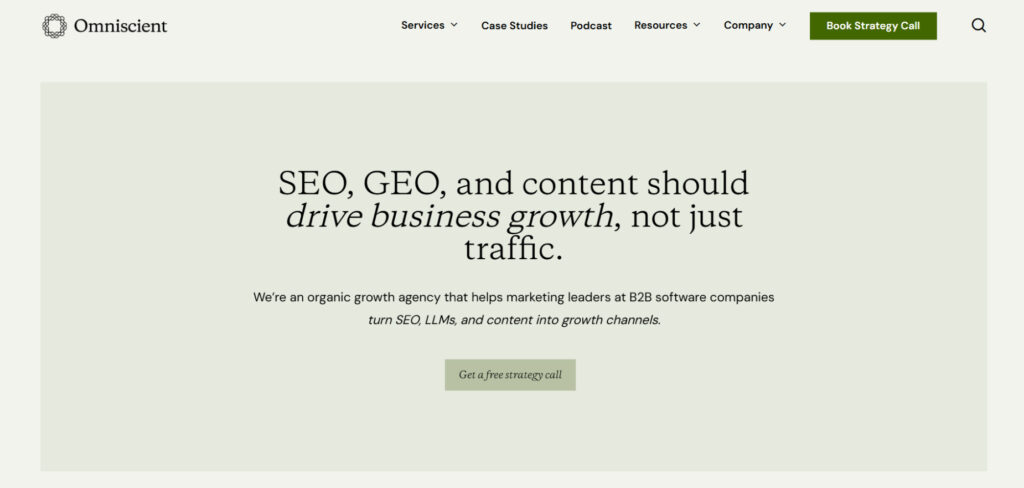
Omniscient Digital, founded in 2019 by alumni from HubSpot, Shopify, and People.ai, has rapidly established itself as one of the most strategically rigorous content marketing agencies in the market. Their positioning is direct: they reject traffic growth as a meaningful goal and build every content program around revenue and pipeline as the primary success metrics. Their research methodology — called OmniscientX — includes competitive analysis, buyer research, content gap analysis, LLM visibility indexing, keyword exploration, product alignment, and SME interviews before strategy development begins. This depth of pre-production research means content programs are built on a foundation of validated commercial intent rather than keyword volume assumptions. In 2026, their GEO (Generative Engine Optimization) practice has become particularly relevant for eCommerce brands seeking to appear in ChatGPT, Perplexity, and Google AI Overview responses when buyers are researching product categories.
Services & Expertise
SEO content strategy, content production, GEO/LLM visibility optimization, link building, content gap analysis, competitive intelligence, and revenue attribution modeling. Particularly strong in integrating traditional SEO content with AI-era answer engine visibility.
Affordability
Custom pricing reflecting the depth of strategic engagement. Programs are fully bespoke and priced based on scope, content volume, and market complexity. Best suited for brands at Series A+ funding stage or generating $5M+ in annual eCommerce revenue.
Reviews & Reputation
Rapidly growing reputation as a top-tier content strategy agency. Clients include high-growth DTC brands and eCommerce companies. Recognized in multiple content marketing industry publications for methodology innovation and strategic depth.
Case Studies & Results
eCommerce clients report measurable LLM citation appearances within 6 months of GEO content programs. Organic traffic programs deliver 100–300% growth over 12 months for brands in competitive product categories. Revenue attribution from content channels consistently improves quarter-over-quarter.
Communication & Transparency
Deep integration with client marketing and leadership teams. Monthly strategy reviews, OmniscientX research documentation, and revenue-linked content dashboards. Clients describe the agency as a true strategic partner embedded in their growth operations.
| Best for: Omnichannel eCommerce brands, enterprise DTC companies, and scaling online retailers that need a full-funnel content marketing partner with proprietary analytics infrastructure connecting content investment to revenue contribution across every channel simultaneously.
Power Digital, founded in 2012 and headquartered in San Diego, California, has grown into one of the most data-sophisticated eCommerce content marketing agencies in the U.S. by building something most agencies lack: proprietary marketing intelligence technology. Their platform, nova, aggregates content performance data from across all channels — organic search, paid media, email, influencer, and social — into a unified dashboard that reveals the true contribution of content investment to revenue outcomes. This capability solves the attribution problem that prevents most eCommerce brands from scaling content budgets with confidence. Power Digital’s content marketing practice serves as the connective tissue across the entire marketing operation: content informs paid strategy, organic rankings reduce paid dependency, and influencer content feeds social proof at scale. Their 400+ person team includes dedicated content strategists, SEO specialists, video producers, influencer managers, and performance analysts who collaborate under a unified revenue growth mandate.
Services & Expertise
Full-funnel content marketing, SEO content strategy, influencer content, social content, email, video production, paid media, CRO, and proprietary nova analytics platform. Particularly strong in omnichannel content attribution and enterprise content operations.
Affordability
Mid-to-enterprise pricing. Monthly retainers typically begin at $5,000 and scale with content volume and channel scope. Premium reflects proprietary technology and full-funnel integration capabilities that standalone content agencies cannot offer.
Reviews & Reputation
Inc. 5000 honoree, Clutch Top Agency recognition, and strong enterprise client review profiles. Clients include national DTC brands and enterprise retailers. Consistently recognized for analytics infrastructure and revenue attribution capabilities.
Case Studies & Results
Enterprise eCommerce clients report 2–4x content-driven revenue growth within 18-month omnichannel content programs. nova-powered attribution reveals content channel contribution that clients consistently cite as transformative for budget allocation decisions.
Communication & Transparency
nova platform provides real-time cross-channel dashboards. Dedicated account teams, monthly executive reviews, and revenue-linked content reporting. Clients cite analytics transparency and strategic depth as primary differentiators from competing agencies.