AGENCY

Best Agency Directories in 2026: Where to List Your Marketing Agency

Referrals still bring in most new business for agencies. But buyers now check a second source before they reply to your proposal: the directories and review sites where they can compare you with five competitors in under a minute. In 2026 those same directories are also feeding the AI assistants that buyers ask, “Which agency should I hire?”

This guide narrows the field to the 10 agency directories most worth your time, with what each one costs today, who it suits, and how to turn a listing into leads. We also flag the directories that have shut down or changed their rules this year, which most older “best directories” lists still recommend.

Quick answer

The best agency directories in 2026 are Clutch, DesignRush, GoodFirms, Sortlist and Agency Spotter for reviews and leads, the partner directories you qualify for (Google Partners, HubSpot, Semrush), your Google Business Profile, and OpenServed for client-verified case studies. Start with free profiles, collect verified reviews, and pay for placement only after a directory sends you qualified leads.


Key takeaways

  • UpCity is gone. Since late November 2025 the site has shown a “no longer supported” notice that sends visitors to Capterra (Search Engine Projects). Remove UpCity badges and links from your site and proposals.
  • Directories now feed AI answers. In an October 2026 test of 207 AI answers, 75 of 105 “who should I hire” answers cited a list article or a directory (ARC Creative Co.).
  • Partner programs got stricter. HubSpot now charges a $400/month partner membership, and Google Partners requires $10,000 in managed ad spend every 90 days.
  • Paid tiers lock you in. Clutch advertising requires a 12-month commitment and DesignRush does not offer refunds. Test with free profiles first.
  • Reviews beat everything. Ranking on Clutch, Sortlist and GoodFirms depends mostly on how many recent, verified reviews you have and how complete your profile is.

How we chose these directories

We started with every directory that appears in the current top Google results and in AI answers for agency hiring questions, then removed any that were shut down, inactive or not relevant to marketing agencies. We scored the rest on these five criteria and kept the 10 that scored highest:

  1. Buyer intent. Businesses use it to shortlist or hire agencies, not just to browse.
  2. Trust signals. It verifies reviews, vets agencies, or ties listings to platform performance.
  3. Visibility. It ranks in Google for agency searches or is cited by AI assistants.
  4. Fair entry cost. It has a free tier or a clear, published price.
  5. Active in 2026. Rankings, reviews or pricing updated this year.

Prices were checked on each directory’s own pricing page or help center on November 10, 2026. Where a directory only quotes on request, we say so.

Agency directories at a glance

| Directory

| Type

| Free option

| Paid from (Nov 2026)

| Best for

Clutch

Review marketplace

Yes

Verified: $499/yr. Sponsorship: quote

Most B2B agencies

DesignRush

Directory + marketplace

Yes

$500/mo (Basic)

Design, web, digital marketing

GoodFirms

Review marketplace

Yes (vetted)

Quote

Tech and IT-adjacent agencies

Sortlist

Matchmaking marketplace

Yes (2 services)

Quote (Sortlist+)

Europe and international work

Agency Spotter

Directory + leads

Yes (1 service)

$2,800/yr (Bronze)

Agencies chasing larger RFPs

Google Partners

Platform partner

Yes (must qualify)

Free

Google Ads agencies

HubSpot Solutions Directory

Platform partner

No

$400/mo membership

HubSpot and RevOps agencies

Semrush Agency Partners

Platform partner

No

$90/mo (Lead Generation)

SEO and content agencies

Google Business Profile

Local + AI citations

Yes

Free

Every agency

OpenServed

Case-study directory

Yes

Free (no paid tiers listed)

Agencies with provable results

Review marketplaces

These are the directories buyers use to compare agencies side by side. Your position depends mostly on verified reviews, so they reward agencies that ask every happy client for a review.

1. Clutch

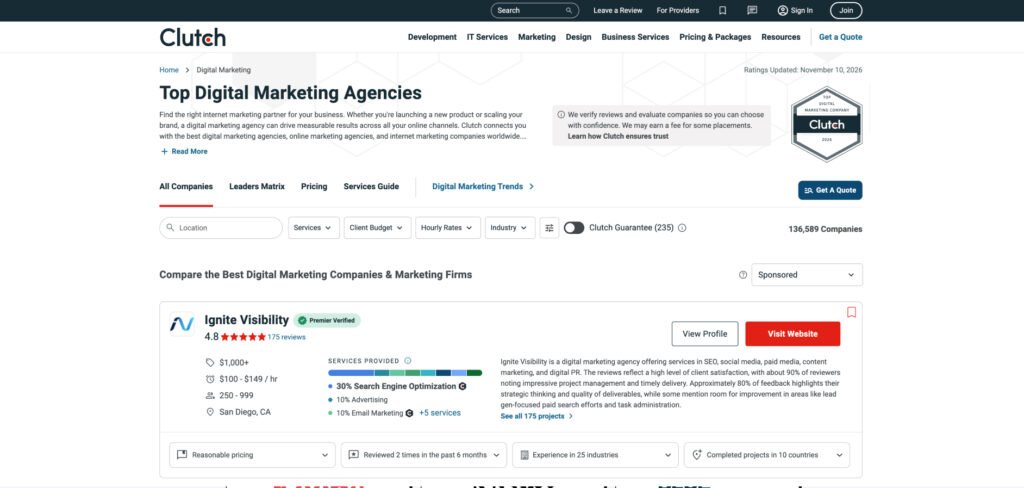
Clutch is the largest B2B services review marketplace and the first place many buyers check. Its analysts verify reviews, often by phone, and its Clutch Rank weighs review recency, review score and review count. Clutch reports 241,000+ verified reviews across 440,000+ profiles, spanning 140+ services and 1,200+ locations.

  • Pricing: Free profile. Clutch Verified costs $499/year, and you only get the badge after collecting three verified reviews. You can request a refund minus an $85 fee within 30 days. Sponsorship and Featured Listings are quoted by level and number of pages, with a 12-month initial term.
  • Premier Verified needs a 3.0+ average rating, 3+ verified reviews and at least one verified review from the past 12 months.
  • Best for: Almost every B2B marketing, web or development agency.
  • Watch out: Rankings move with review recency. A profile that stops collecting reviews slides down even if past reviews are excellent.
  • Website: clutch.co

Pro tip

Ask for the Clutch review right after a measurable win, not at project end. Clutch’s own research says 47% of B2B buyers read at least six reviews before deciding, so aim for six recent reviews before you consider paying for placement.

2. DesignRush

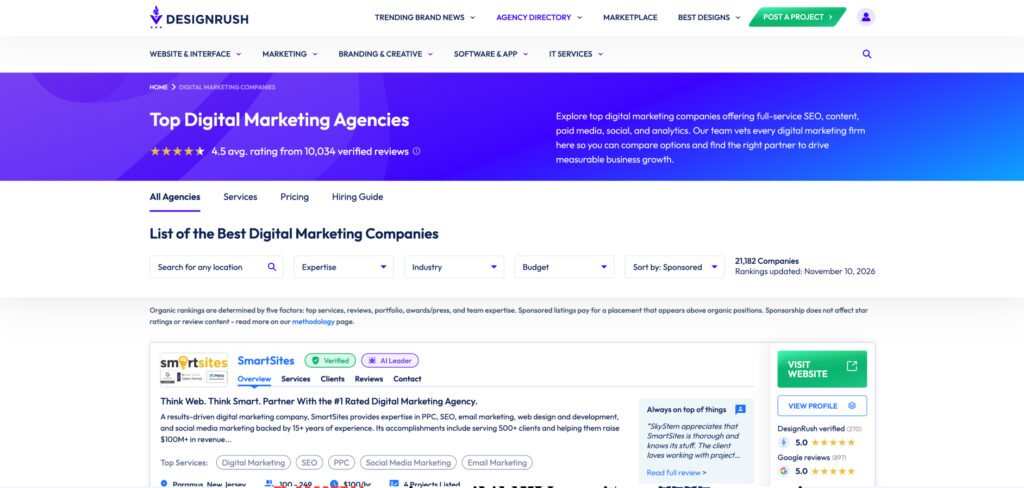
DesignRush combines an agency directory, editorial “best agencies” lists, design awards and a project marketplace where businesses post RFPs. Its strength is design, web development and digital marketing, and its category pages rank well in Google.

  • Pricing: Free listing. Sponsorship starts at $500/month (Basic, billed quarterly) for a top position in one relevant category; Standard starts at $2,000/month and Premium at $5,000/month, adding marketplace access and visitor insights. Sponsorships are secured month by month and are non-refundable.
  • Marketplace: DesignRush says more than 80% of its marketplace RFPs are US-based projects.
  • Best for: Creative, branding, web and digital marketing agencies selling to US buyers.
  • Watch out: Top category positions are paid, so a free profile can sit far down busy categories. Pick a narrow category where you can rank.
  • Website: designrush.com

Pro tip

Enter your best project in DesignRush’s design awards. A win gives you a badge for your proposals and extra editorial exposure without a sponsorship.

3. GoodFirms

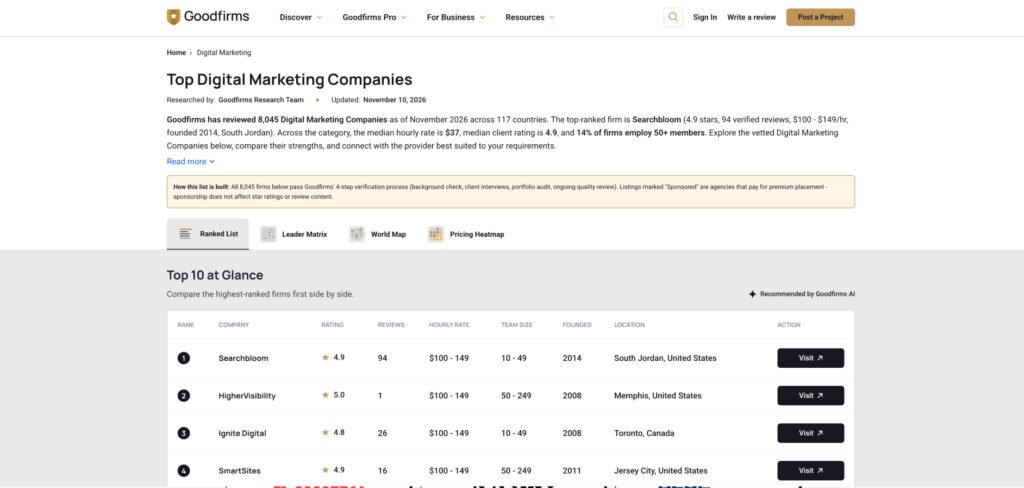
GoodFirms is a B2B review platform founded in 2015 with a research team that vets each company. It leans toward IT and software services but has solid marketing, SEO and design categories. It reports a 23% acceptance rate for free profiles and a four-step research verification.

  • Pricing: Free forever profile. Paid Start-Up and Sponsored plans raise your priority in category lists; prices are quoted per category. Third-party pricing sites list plans from about $300/month billed yearly, so treat that as a ballpark.
  • Best for: Agencies selling to tech companies, and agencies that also offer development.
  • Watch out: Not every application is accepted. Submit a complete profile with a real portfolio on your first try.
  • Website: goodfirms.co

4. Sortlist

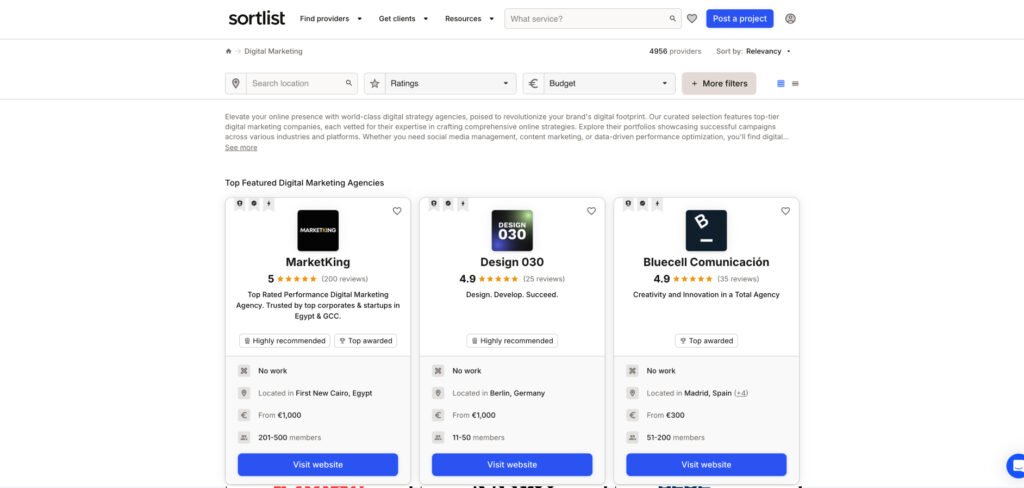
Sortlist is a Brussels-based marketplace where companies post a brief and get matched with agencies. It claims a network of 90,000+ providers and is especially strong in Europe.

  • Pricing: Free profile, but showing more than two services on your public profile requires a paid Sortlist+ plan. Plan prices are quoted on request.
  • How matching works: Sortlist selects agencies by their target markets (services by location) and recommends at least six recent works, under two years old, per active service.
  • Best for: Agencies targeting European clients or international projects.
  • Watch out: Agency reviews of Sortlist are mixed. Some report strong ROI, others say paid leads did not convert. Track every lead before renewing.
  • Website: sortlist.com

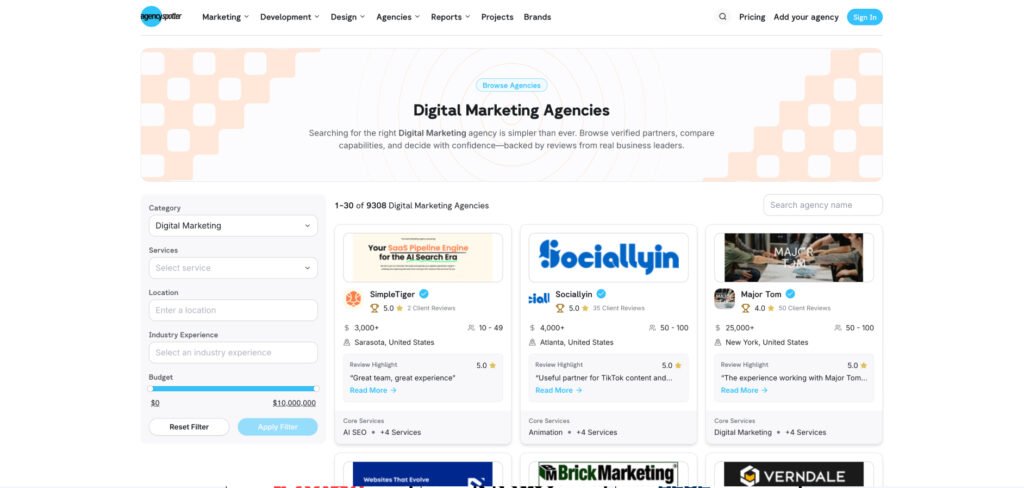
5. Agency Spotter

Agency Spotter is a long-running US directory that lets buyers search by service, industry and location and post projects. Paid members can view and contact leads.

  • Pricing: Free profile with one searchable service and no lead access. Bronze is $2,800/year, Silver $5,040/year and Gold $10,680/year, each adding promoted placement, more promoted services and lead access.
  • Best for: Mid-size agencies pursuing larger brand and enterprise projects.
  • Watch out: The free tier is mostly a backlink and a credibility page. The lead value sits in paid plans, so calculate payback first.
  • Website: agencyspotter.com

Platform partner directories

Partner directories are run by the platforms your clients already use. Buyers searching them already know what tool they need help with, which makes these some of the highest-intent leads you can get. Each one requires you to earn a status first. If you specialize in another platform, such as Shopify, Meta, Klaviyo or Webflow, its partner directory deserves the same attention (see how top partners position themselves in our list of the best Shopify experts).

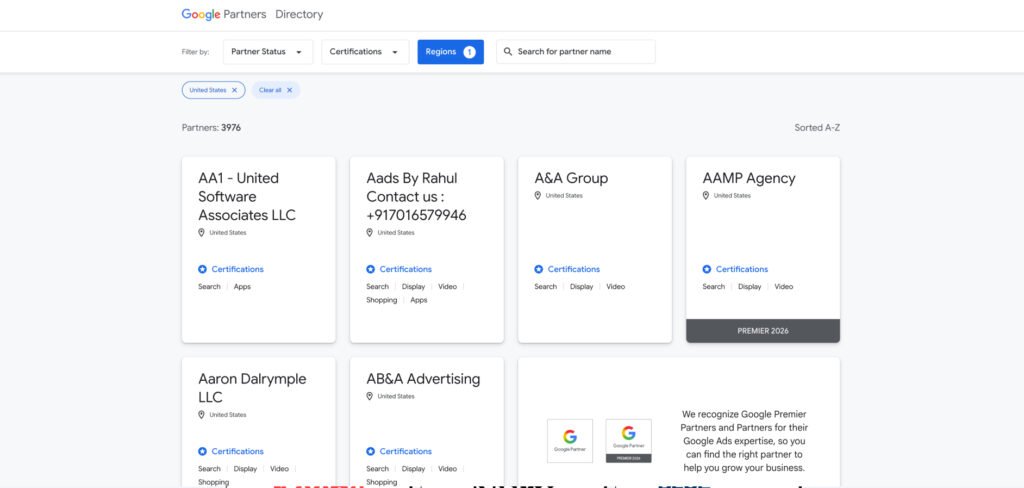
6. Google Partners

Google’s official directory of certified Google Ads agencies. A Partner badge is one of the most recognized trust signals for paid search buyers.

  • Requirements: A 70% optimization score on your manager account, $10,000 in ad spend across managed accounts over 90 days, and Google Ads certification for at least half of your account strategists. Google checks these daily.
  • Premier Partner: Reserved for the top 3% of partners in each country, reviewed every year.
  • Pricing: Free.
  • Best for: PPC and full-funnel agencies managing Google Ads.
  • Website: Google Partners directory

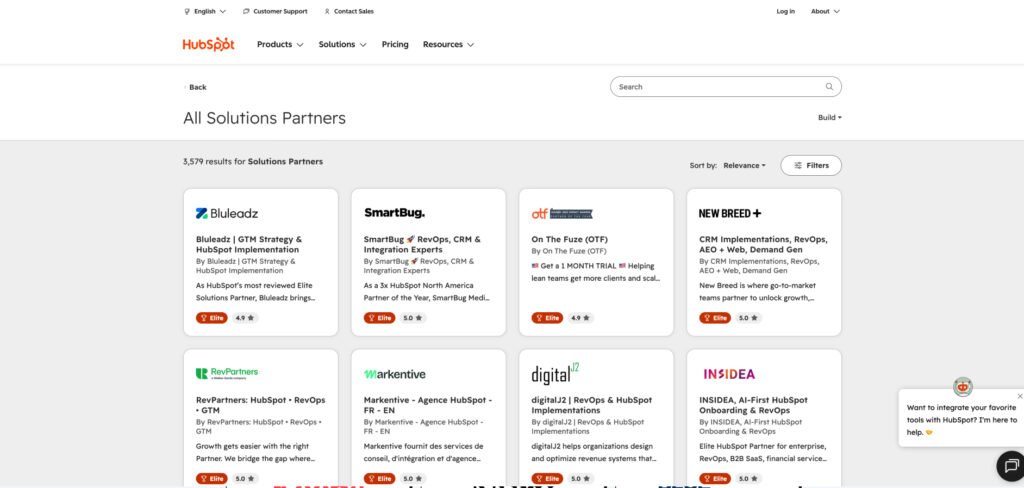
7. HubSpot Solutions Directory

HubSpot’s directory lists certified Solutions Partners with reviews, tiers (Gold to Elite) and service filters. Buyers on HubSpot often hire straight from it.

  • Pricing: Since July 15, 2026, every partner must buy a Partner Program Membership at $400/month, renewed annually. Some existing partners qualified for a fee waiver, and the old Provider program closed on August 15, 2026.
  • Best for: Inbound, CRM and RevOps agencies built around HubSpot.
  • Watch out: Directory reviews also count toward HubSpot’s partner awards, so collect them consistently.
  • Website: HubSpot Solutions Directory

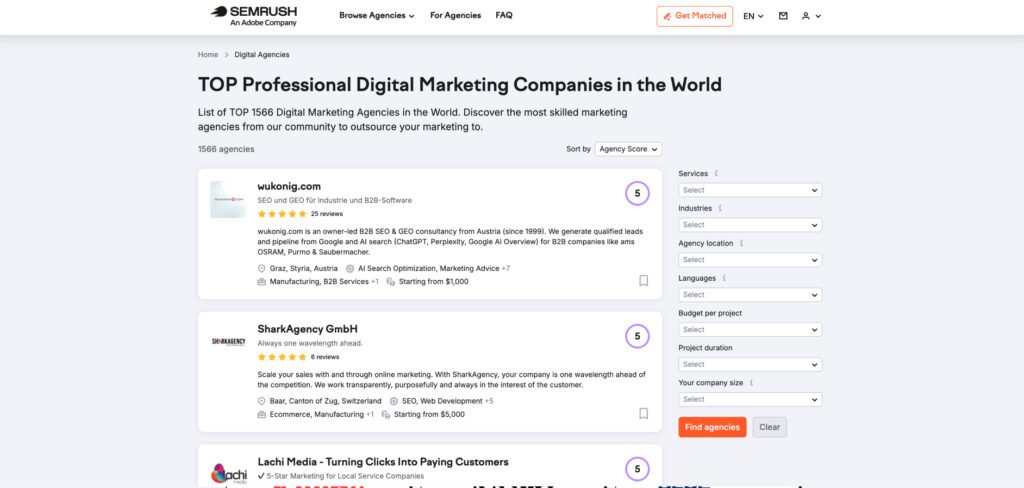
8. Semrush Agency Partners

Semrush lists agencies on a dedicated platform and runs a “Get Matched” service that sends buyer briefs to fitting agencies. Each profile gets an Agency Score from 1 to 5, based on the health of your own website and your Semrush Academy certifications.

  • Pricing: Access is part of Semrush’s Lead Generation Solution, listed at $90/month in its knowledge base. Confirm current pricing in your account.
  • Best for: SEO, content and digital marketing agencies.
  • Why it matters in 2026: It was one of the directories AI engines cited in the October 2026 hiring study.
  • Website: Semrush Agency Partners

Pro tip

Fix your own site’s technical SEO before you publish the profile. Your Agency Score partly reflects your own site health, and a low score next to an SEO agency’s name is a bad look.

Local and AI-visibility listing

Not an agency directory in the classic sense, but now essential, because AI assistants and local search lean on it.

9. Google Business Profile

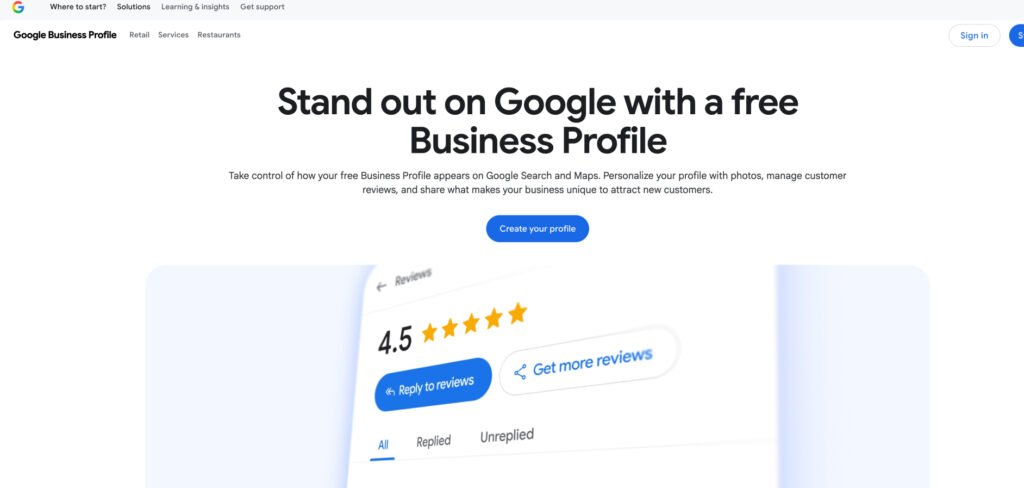
Your Google Business Profile powers your Google Maps listing and local results. In the October 2026 study, every link ChatGPT gave in its agency hiring answers pointed to Google Maps. If you do one thing from this list today, make it this.

  • Pricing: Free.
  • What to do: Pick precise categories (for example “Internet marketing service”), list every service, add real photos, post updates monthly and reply to every review.
  • Remote agencies: You can still list as a service-area business with a hidden address.
  • Website: Google Business Profile

While you are at it, claim your LinkedIn company page, Bing Places and Apple Business Connect listings. They are free one-time setups that keep your name, address and phone consistent across the web, which search engines and AI tools use to confirm your business is real.

A newer directory worth joining

Several directories launched in 2025 and 2026 around case studies and AI search. One stands out for how it verifies results.

10. OpenServed

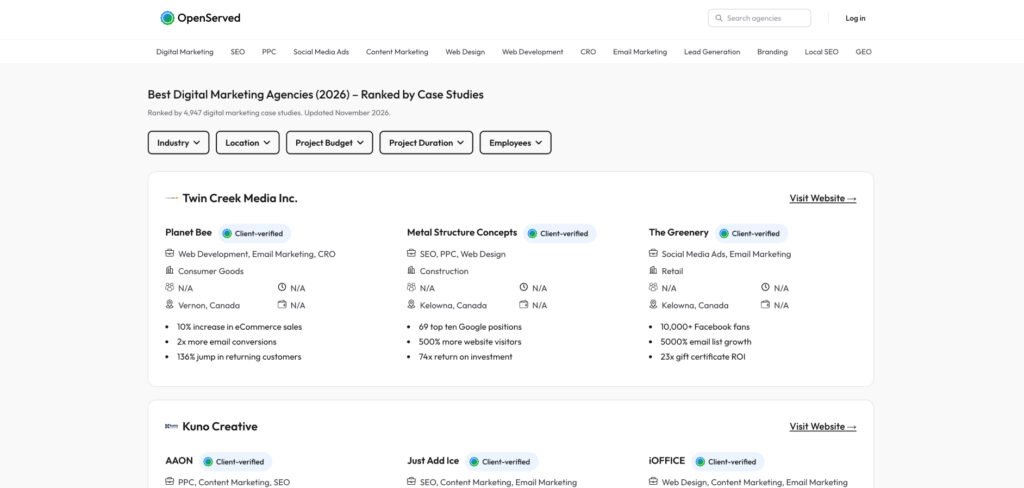
OpenServed is a marketing agency directory that ranks agencies by client-verified case studies instead of star ratings. Agencies add case studies, and OpenServed emails the named client at their company domain so they can confirm or dispute the results with one click. Confirmed case studies earn a “Client-verified” badge, and agencies cannot approve their own.

  • Pricing: Free. Claiming and managing a profile costs nothing, and the site lists no paid placement or sponsorship tiers.
  • How ranking works: A client-verified case study is worth about 20 times the most an unverified one can earn. Smaller factors include result stats, a client testimonial, an image, recency (fading over five years) and filled-in industry, company size, location and budget. On service pages, agencies with work across more industries keep more of their score.
  • Categories: 13 services, including SEO, PPC, social media ads, content, web design and development, CRO, email, lead generation, branding, local SEO and GEO (AI search optimization).
  • Best for: Agencies with measurable, client-approved results, and newer agencies that have strong work but few reviews elsewhere.
  • Watch out: It is a young directory and does not publish traffic or listing numbers, so treat it as a free credibility asset while its buyer audience grows.
  • Website: openserved.com

Pro tip

Verify at least one case study per service you want to rank for. Only case studies tagged with a service count toward that service page, and one verified result outweighs a stack of unverified ones. A verified case study page is also a link you can share in proposals.

Directories to skip, or handle carefully

  • UpCity. Shut down. Remove old badges and profile links.
  • Paid “best agencies” list placements. Some sites sell spots on their ranked lists for hundreds of dollars a month. List articles are cited heavily by AI engines, so placements can work, but check that the list ranks in Google, that it discloses paid placement, and that the other listed agencies are credible.
  • Mass-submission and “500 directories” packages. Low-quality directories add no leads and can look like link spam. Ten complete profiles beat 200 empty ones.
  • Software-only review sites. Capterra, GetApp and Software Advice list software products, not agencies. G2 is mainly software too. List there only if you sell a software product.

Which directories should your agency use?

You do not need all 10. Start with the free profiles that match your specialty, then add paid tiers based on results.

Agency type

Start here (first 30 days)

Add later

SEO / content

Clutch, Semrush Agency Partners, Google Business Profile

OpenServed, GoodFirms, DesignRush

PPC / paid media

Google Partners, Clutch, Google Business Profile

OpenServed, Agency Spotter

Web design / branding

DesignRush, Clutch, Google Business Profile

Agency Spotter, Sortlist

HubSpot / B2B RevOps

HubSpot Solutions Directory, Clutch

Agency Spotter, GoodFirms

European / international

Sortlist, Clutch

GoodFirms, OpenServed

Local SMB agency

Google Business Profile, Clutch city pages

DesignRush local categories

How to build a directory profile that wins clients

Most agency profiles are half-finished, which is why a complete one stands out. Use this checklist on every directory:

  1. Lead with one clear positioning line. “SEO agency for B2B SaaS” beats “full-service digital agency” every time, in both directory search and AI answers.
  2. Use the same name, address, phone and description everywhere. Consistency helps search engines and AI tools confirm your business.
  3. List only the services you want to sell. Sortlist and Agency Spotter limit services on free plans anyway, so lead with your most profitable one.
  4. Add 3 to 6 case studies with numbers. Name the client (with permission), the problem, what you did and the result, such as “organic leads up 140% in 9 months.”
  5. Show your pricing. Minimum project size and hourly rate filters are used by most buyers. Hiding them removes you from filtered searches.
  6. Collect reviews on a schedule. Ask after each milestone and aim for at least one new verified review per platform every quarter, since recency drives ranking.
  7. Reply to every review, good or bad, within a week.
  8. Tag every website link with UTMs (for example utm_source=clutch) so you can see which directories send traffic and leads in GA4.
  9. Embed review widgets on your site and monitor new reviews with a reputation tool. See why your agency’s stack needs an ORM tool.
  10. Update every profile twice a year. Refresh case studies, team size and services each January and July.

Free vs paid listings: how to decide

Paid placement is worth it only when one directory can bring in enough clients to cover its cost several times over. Run the numbers before you sign:

  1. Find your client value. Multiply average monthly retainer by average months retained, then by gross margin. Example: $4,000 per month for 10 months at a 40% margin is $16,000 gross profit per client.
  2. Find your cost per client from the directory. Example: Agency Spotter Silver costs $5,040/year. If it sends 10 qualified leads and you close 20%, you win 2 clients, so each costs $2,520.
  3. Compare. $16,000 in gross profit against $2,520 in acquisition cost is about a 6:1 ratio, well above the 3:1 benchmark many agencies use. If you would close zero or one client, stay on the free tier.

Use our free CAC calculator and LTV:CAC ratio calculator to plug in your own numbers. The figures above are illustrative, not typical results.

Rule of thumb

Stay free on a directory for 90 days. If the free profile produces at least one qualified lead, test the cheapest paid tier for one term. If it produces nothing, fix the profile before spending a dollar, because placement cannot rescue a weak profile.

Your 90-day directory plan

Days 1 to 14: foundations

  • Claim or update your Google Business Profile, LinkedIn page, Bing Places and Apple Business Connect.
  • Create free profiles on Clutch, DesignRush and GoodFirms, plus Sortlist if you sell into Europe.
  • Write one master description, service list and three case studies, then reuse them everywhere.

Days 15 to 45: reviews and partner status

  • Ask your five happiest clients for a Clutch review, then rotate later requests across platforms.
  • Publish your best three case studies on OpenServed and ask those clients to verify the results, which takes them one click.
  • Apply for the partner directories you qualify for: Google Partners, HubSpot or Semrush.
  • Add UTM tags to every profile link and set up a simple lead-source field in your CRM.

Days 46 to 90: measure and invest

  • Compare traffic, leads and closed deals by directory.
  • Double down on the one or two directories producing leads: more reviews, an awards entry, or a paid trial.
  • Drop or pause any profile that produced nothing, and check how AI assistants describe your agency by asking them your buyers’ questions.

Frequently asked questions

What is the best agency directory in 2026?

For most B2B marketing agencies, Clutch is the best single directory because of its verified reviews, buyer traffic and frequent citations in AI answers. Design-led agencies often get more from DesignRush, and agencies built on one platform usually get their best leads from that platform’s partner directory.

Are agency directories still worth it in 2026?

Yes, if you treat them as review and credibility platforms rather than passive listings. Buyers check them before hiring, and AI assistants cite directories and list articles in most agency hiring answers. Complete profiles with recent reviews outperform incomplete ones by a wide margin.

Which agency directories are free?

Clutch, DesignRush, GoodFirms, Sortlist, Agency Spotter, OpenServed, Google Partners and Google Business Profile all have free options. HubSpot’s directory now requires a $400/month partner membership, and Semrush Agency Partners is part of a paid Semrush plan.

How much does it cost to be listed on Clutch?

A basic Clutch profile is free. Clutch Verified costs $499 per year and requires three verified reviews to earn the badge. Sponsorship and Featured Listings are priced by level and number of pages, with a 12-month minimum commitment.

Is UpCity still available?

No. Since late November 2025, UpCity.com has displayed a message that the site is no longer supported and directs visitors to Capterra, a software review site. Agencies should remove UpCity badges and profile links from their websites and proposals.

Do directory backlinks help SEO?

They help a little. Directory links add trust and referral traffic, and some are followed links, but the bigger SEO value is that directory profiles themselves rank for “best agency” searches and feed AI answers. Focus on a few high-quality directories rather than mass submissions.

How many directories should my agency be listed on?

Most agencies do well with 5 to 10 complete profiles: Google Business Profile, LinkedIn, two or three review marketplaces, and every partner directory you qualify for. It is better to keep a few profiles current with fresh reviews than to spread thin across dozens.

How do I get my agency recommended by ChatGPT?

Keep a complete Google Business Profile, since ChatGPT’s hiring answers in one 2026 study linked only to Google Maps. Then build review-rich profiles on Clutch and similar directories, publish case studies with clear results on your site, and try to earn places on credible “best agencies” lists.

Final thoughts

The best agency directories in 2026 are the ones your buyers and their AI assistants already trust. For most agencies that means a strong Google Business Profile, a review-rich Clutch profile, one or two specialist directories such as DesignRush or Sortlist, and every partner directory you can earn your way into. Start free, collect reviews on a schedule, measure every lead, and pay only for what proves itself.
Bill Nash's face

About the author, Bill Nash

Bill Nash is the CMO of Marketing LTB with over a decade of experience, he has driven growth for Fortune 500 companies and startups through data-driven campaigns and advanced marketing technologies. He has written over 400 pieces of content about marketing, covering topics like marketing tips, guides, AI in advertising, advanced PPC strategies, conversion optimization, and others.