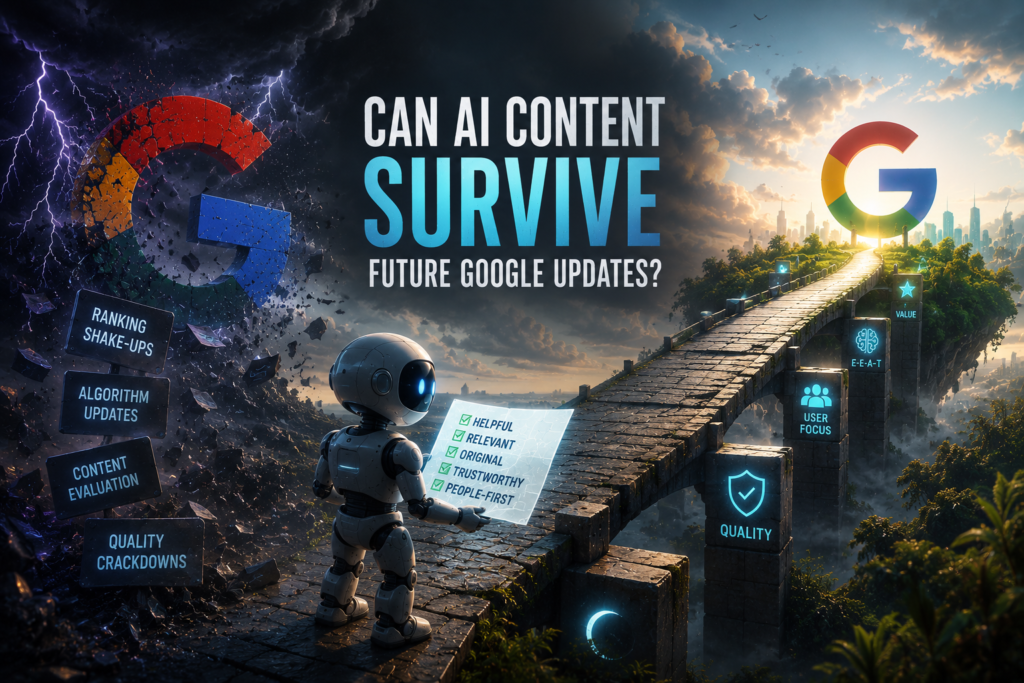
Content writing, it now feels like a shortcut to easy traffic. And the credit for this delusion goes to AI content writing tools. The reality is bitter and opposite. There is no easy traffic shortcut, as search engines like Google are becoming stricter on content quality.
We are seeing continuous updates from Google, and with every coming update, thin AI content is getting punished. Still, many people are using AI content and getting traffic well because they are doing it the right way.
Others who rely completely on thin AI content often ask why AI content doesn’t work for them. And, if we rely on AI-generated content, will it still be effective in the future? This is what all will be answered in this blog post.
What Google Actually Says About AI Content?
If you are among the people who think that Google hates AI content, you are wrong. Because Google itself has cleared it so many times that it has no issue with AI-created content if it is helping users and delivering value.
This is an important point that most people misunderstand.
Google does not care whether you used ChatGPT or wrote manually on your laptop at 2 AM. Google cares about one thing: Does your content help people?
That is why many AI-generated articles still rank today. At the same time, many human-written articles also fail.
The real target is low-quality content.
Google also talks about scaled content abuse. This happens when websites publish large amounts of pages, mainly to manipulate rankings instead of helping users.
And honestly, this is where most websites relying on AI content failed.
What Type of AI Content Can Survive Google Updates?
Not all AI content is bad. In fact, we ourselves use AI tools during our writing process. Many professional writers do the same. But there is a huge difference between AI-assisted writing and fully automated publishing. Assisted content can win, but automated content has no chance of ranking.
Here is the type of AI content that can easily survive Google Updates:
1. Humanized Content
Raw AI output usually needs to be humanized. To humanize content, you have to do good editing. This involves removing fillers and simplifying the language.
Then comes the readability. In fact, readability is very, very important. AI tools usually deliver complex readability. You have to make it good so the general audience can consume the content easily.
Many people think AI saves time by removing editing. In reality, editing is now more important than ever.
Doing editing itself is time-consuming and requires more attention. But you can get all this done with the help of an AI text humanizer like Super Humanizer. It not only breaks AI patterns and removes predictive elements but also makes the content good to read.
2. Non-Commodity Content
This is where many bloggers still struggle. If your article sounds like every other article online, future updates may eventually push it down.
Try adding:
- personal opinions
- Observations
- mistakes
- testing results
In short, you now have to provide unique angles. For example, instead of writing:
“AI content is growing rapidly”
You should write something like:
“We started seeing ranking drops on websites that published hundreds of unedited AI articles every week.”
That feels more real because it comes from actual observation.
3. Content With Real Experience
The safest AI content is content backed by real experience. This involves content that shows:
- personal testing
- screenshots
- case studies with results
- Comparisons (honest ones)
For example, a writer from our team wrote an article about the best AI humanizer tools. In that piece of content, the writer actually shares the experience of testing different AI humanizer tools. And that thing made the article stronger and more trustworthy.
AI can help structure content. But experience must come from you.
Why have many AI Content Websites Lost Rankings?
During Google core updates, we often see many AI content websites start to lose rankings. Most of the websites that lose ranking have one common problem: thin, identical, and unhelpful AI content.
Because all of them work on high-volume, viral topics and push content through AI writing tools. No editing, no personalization. They just run a command, copy text, and publish.
Result? Poor content quality.
Honestly, tell yourself, won’t they deserve to be punished?
Yes, right?
That is why during Google core updates, website scaling thin AI content gets deranked. Some even get penalized.
Can AI Content Survive Future Google Updates – Final Talk
Yes. But not the lazy version of it (we mean thin AI content). AI content can perform well if you use it wisely and for assistance only. For example, you can use AI to get answers and then add value and share your personal opinion and experience on the topic. That will make the content feel genuine and helpful.
Google is not fighting AI. It is fighting low-value content. And honestly, that is exactly how it should be.